

Year of Kujawsko-Pomorskie people of cinema: Remembering the Filmmakers We Have Lost
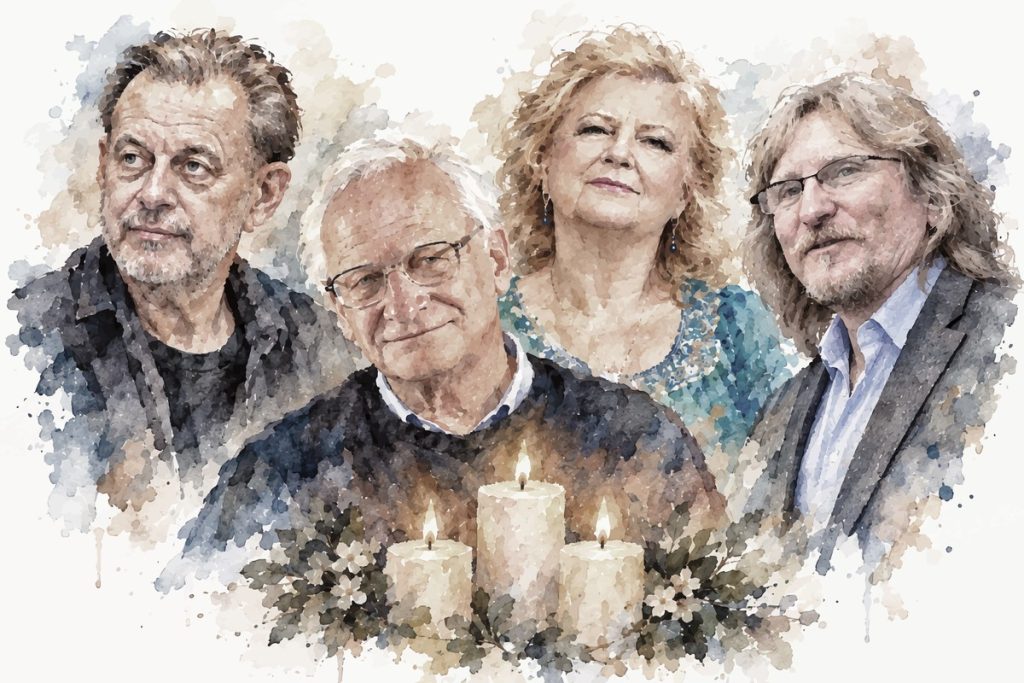
On 1 November, All Saints’ Day, people across Poland visit cemeteries, light candles and remember those who are no longer with us. It is a time for reflection, remembrance and gratitude for the legacy they have left behind. Among those we have bid farewell to in 2026 are film professionals associated with the Kujawsko-Pomorskie region – actors, producers and production designers who helped shape Polish culture over the years. Although they are gone, their performances, films and artistic achievements remain with us. We remember those whose lives and work have become part of the history of Polish cinema and left a lasting impression on audiences.
Stanisława Celińska was one of Poland’s most versatile actresses, equally compelling on stage, in film and on television. Her career encompassed dramatic and comedic roles as well as musical performances. Her distinctive voice and remarkable ability to create convincing characters earned her the affection of generations of audiences.
She was born on 29 April 1947 in Warsaw. In 1969, she graduated from the State Higher School of Theatre in Warsaw, where she studied under Ryszarda Hanin. She made her stage debut while still a student and soon began working with Warsaw’s Contemporary Theatre. Her talent quickly attracted the attention of filmmakers. One of her first major film roles was in Andrzej Wajda’s Landscape After the Battle (1970), in which she appeared alongside Daniel Olbrychski.
In the following years, Celińska appeared in numerous acclaimed productions, including Stanisław Bareja’s There Is No Rose Without Fire, Jerzy Antczak’s Nights and Days and Janusz Majewski’s Hotel Pacific. Audiences also remember her from popular television series, including Alternatywy 4 and Zmiennicy. Her career, however, extended beyond acting. Music also played an important role in her artistic life, and her emotionally expressive, deeply personal interpretations of songs won widespread acclaim.
The Kujawsko-Pomorskie Region holds a special place in her film biography. In 1972, Stanisława Celińska appeared in Krzysztof Zanussi’s Hypothesis, a short film shot in Toruń. Years later, Zanussi recalled their collaboration, noting that Celińska had portrayed a drowning woman and that revisiting those memories stirred deeply personal emotions.
Stanisława Celińska passed away on 12 May 2026. She left behind an extensive artistic legacy, including dozens of memorable performances and unforgettable musical interpretations.
Janusz Hetman was a respected film producer, painter and influential figure who contributed to Polish cinema and supported the development of major film events over many years. He was born on 27 May 1955 in Bydgoszcz, a city with which he remained closely connected throughout his life. His professional career encompassed both Polish productions and international projects involving renowned figures in world cinema.
Trained as a painter, Hetman brought his artistic sensitivity and broad interest in the arts to his work as a film producer. He co-founded the Bydgoszcz-based Lucky Bob studio, whose artistic director is filmmaker Wojciech Smarzowski. Their long-standing collaboration included The Wedding (2021), Clergy and The Mighty Angel. One of their final joint projects was Home Sweet Home (2025), a film addressing domestic violence.
Hetman was also involved in internationally recognised productions. He worked with David Lynch on Inland Empire, Roman Polanski on The Palace and Jerzy Skolimowski on the award-winning EO. His credits also included work on Peter Weir’s Master and Commander: The Far Side of the World. He was a member of both the Polish Film Academy and the European Film Academy, reflecting his established position within the professional film community.
The Kujawsko-Pomorskie Region held a particularly important place in Janusz Hetman’s life. Bydgoszcz was his hometown and a significant centre of his professional activities. He was also actively involved in Toruń’s film community. For many years, he served as director and vice-president of the Tumult Foundation, which organises the International Film Festival of the Art of Cinematography, Camerimage.
Janusz Hetman passed away on 1 February 2026, at the age of 70. He left behind a legacy of important Polish films, collaborations with distinguished directors and a lasting contribution to the development of film culture.
Stanisław Janicki was an outstanding film historian, critic, journalist, director and screenwriter, and above all one of Poland’s most influential popularisers of cinema history. For decades, he introduced audiences to the achievements of pre-war filmmaking, revived memories of stars from earlier generations and demonstrated that films from the past could still captivate contemporary viewers.
He was born on 11 November 1933 in Czechowice-Dziedzice. In 1955, he graduated in journalism with a specialisation in film from the University of Warsaw. He worked for the editorial teams of Żołnierz Wolności, Film and Kino, establishing himself as a highly respected authority on cinema. He was also a documentary filmmaker, lecturer and author. His publications included Polish Film from A to Z, In Old Polish Cinema and Japanese Cinema.
He gained his greatest popularity through the television programme W starym kinie (In the Old Cinema), which he hosted from 1967 to 1999. Through his engaging narratives, audiences discovered the history of Polish interwar cinema, explored forgotten productions and rediscovered artists such as Eugeniusz Bodo, Aleksander Ford and Helena Grossówna. His distinctive speaking style, extensive knowledge and personal enthusiasm for the films he presented made Janicki a familiar and beloved figure on Polish television. For many years, he also hosted the radio programme Stanisław Janicki’s Odeon on RMF Classic.
He passed away in May 2026, aged 92, leaving behind an exceptional legacy of film documentation and popularisation. His achievements were recognised with numerous honours, including the Gold Medal for Merit to Culture – Gloria Artis and the Officer’s Cross of the Order of Polonia Restituta.
Stanisław Janicki was also a recipient of the Pola Negri Film Award of the Marshal of the Kujawsko-Pomorskie Region. In 2023, he received this distinction for lifetime achievement during the Old Film Festival in Bydgoszcz.
His connection with the Kujawsko-Pomorskie region was also reflected in his particular admiration for Helena Grossówna, a pre-war film actress born in Toruń. Janicki frequently highlighted her talent and importance to Polish film culture.
Ancient Rome on screen, historical battlefields, contemporary Polish cities and familiar settings from popular television series – their visual appearance is shaped not only by directors and cinematographers, but also by production designers. One experienced representative of this profession was Marian Zawaliński, an artist involved in numerous important Polish film productions. His biography also has a strong connection to the Kujawsko-Pomorskie region: he was born on 2 May 1959 in Solec Kujawski.
Zawaliński graduated from the Faculty of Interior Design at the Academy of Fine Arts in Warsaw in 1986. His professional credits included several dozen film and television productions. He worked on films such as Lech Majewski’s Wojaczek, Andrzej Żuławski’s She-Shaman, Radosław Piwowarski’s The Dark Side of Venus, Katarzyna Rosłaniec’s Mall Girls and Jacek Bromski’s God’s Little Garden. He also contributed to the production design of The Secret of Westerplatte and 303 Squadron: The True Story. His name can also be found among the crews of popular television series, including Klan and M jak miłość.
One of the most demanding projects of his career was Jerzy Kawalerowicz’s Quo Vadis (2001). As second production designer, Zawaliński helped create the monumental sets representing ancient Rome. Among other responsibilities, he worked on the cinematic reconstruction of Trastevere, the district where part of the story takes place.
Paweł Jankowski
Promotion Department
30 October 2026