

Railway Workers’ Day – wishing railway staff job satisfaction and smiles from passengers
Every day, 370 passenger trains operate on railway routes across Kujawy and Pomorze, with 150 train drivers, train managers and conductors employed by our two railway operators, Polregio and Arriva RP, ensuring the safety of passengers travelling on regional government-funded services. On the occasion of Railway Workers’ Day, Marshal Piotr Całbecki extends his best wishes to railway employees.
“Without the dedication of railway employees, we would not be able to celebrate our achievements in organising passenger rail services – growing passenger numbers, more kilometres travelled and record investment in rail transport. I wish everyone involved in providing direct passenger services, ensuring passenger safety and managing the technical aspects of railway operations job satisfaction, safe working conditions and smiles from passengers,” says Marshal Piotr Całbecki.
Millions of kilometres, millions of passengers
The Marshal of the Region plays an important role in organising passenger rail services in the Kujawsko-Pomorskie region. Our responsibilities include:
- planning the regional railway network
- financing passenger rail services
- selecting railway operators
- monitoring the quality of services provided by railway operators
- setting passenger fares
- cooperating with railway operators.
In organising regional rail transport, the regional government works closely with railway companies (Polskie Koleje Państwowe SA and PKP Polskie Linie Kolejowe) and the Ministry of Infrastructure, which oversees their operations. Thanks to this cooperation, residents can travel more quickly and safely. Investments made by PKP PLK enable the Marshal’s Office to introduce new services, allow train drivers to operate at higher speeds and provide passengers with comfortable conditions while waiting for their trains.
In the coming year, our trains will cover 8 million kilometres. This represents an increase of 45 per cent compared with five years ago and 400,000 kilometres more than in the current year.
The number of passengers choosing regional government-funded trains for their journeys to work, school or holiday destinations is also steadily increasing. This year, passenger numbers will exceed 8 million, reflecting their confidence in our railway operators.
Polregio and Arriva RP, selected through a public tender procedure, will operate rail services across the Kujawsko-Pomorskie region until 2030.
Number of daily train services operated by individual railway companies:
Arriva RP:
- 175 trains on weekdays
- 149 trains on Saturdays
- 136 trains on Sundays and public holidays.
Polregio:
- 194 trains on weekdays
- 134 trains on Saturdays
- 128 trains on Sundays and public holidays.
This year alone, railway operators received PLN 126.1 million for Polregio and PLN 122.3 million for Arriva for the provision of passenger rail services.
Train drivers, conductors and dispatchers
Every day, 70 employees work as train crew members (drivers and conductors) on services operated by Arriva. However, they represent only part of the team, as dispatchers, technical and maintenance personnel, as well as administrative staff, are also directly involved in daily railway operations. Altogether, the team comprises 260 employees. On any given day, Polregio employs 39 train drivers, 36 train managers and six conductors on the services it operates.
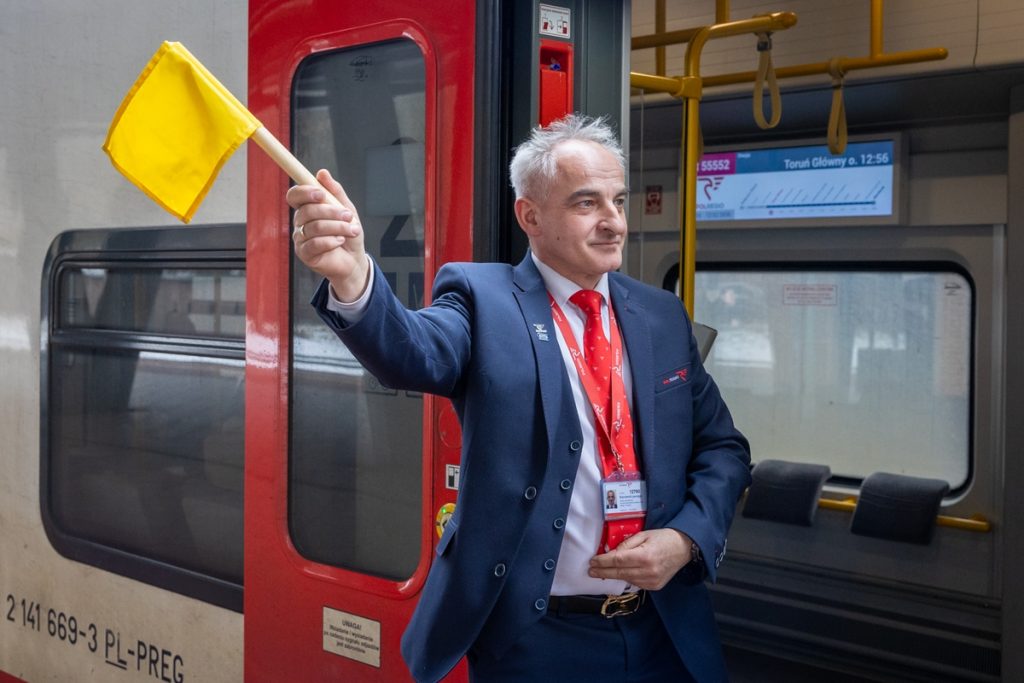
Read the interview with Piotr Sztopel, a conductor and train manager at Polregio.
Train drivers are responsible for operating trains safely and in accordance with applicable regulations. Conductors ensure passenger safety and comfort, supervise safe boarding and alighting, provide passengers with information, sell and inspect tickets, and respond to everyday and sometimes unusual situations during journeys.
Dispatchers oversee daily railway operations, ensure appropriate staffing of trains and respond to disruptions in rail traffic. They also coordinate the work of train crews and take measures to ensure that services operate safely and as punctually as possible.
It is also important to recognise the contribution of technical and maintenance personnel, who are responsible for maintaining rolling stock and ensuring its technical reliability. Their daily work is essential to ensuring that trains carry passengers safely and operate reliably across the railway network.
Railway stations, tracks and rolling stock
In 2027, we will allocate PLN 290 million to organising passenger rail services in the region. This amount includes PLN 39 million in expenditure incurred by the Marshal’s Office for access to railway infrastructure and the use of railway stations.
See also:
- Bydgoszcz Stary Fordon to be included in the railway timetable from December
- Nakło and Brodnica – new railway stops from December
- New and refurbished railway stations and stops
The regional government not only uses existing railway infrastructure but also benefits from newly developed infrastructure thanks to its cooperation with PKP PLK. Investments undertaken by the railway company enable the introduction of new services and the restoration of previously suspended connections.
Last year, PKP PLK, the company responsible for managing railway infrastructure, modernised railway line No. 245, enabling us to restore services between Aleksandrów Kujawski and Ciechocinek after a 14-year suspension.
Other restored railway connections include:
- Wierzchucin to Laskowice Pomorskie in Tuchola County (after six years)
- Brodnica to Rypin (after 25 years)
- Nakło nad Notecią via Kcynia (Nakło County) to Gołańcz in the Wielkopolskie Region (after 22 years).
The launch of these services is preceded by the refurbishment of railway tracks, level crossings, stops and stations.
See also:
- Travelling by train from Grudziądz to Jabłonowo Pomorskie – faster, more comfortably and more safely
- More trains, more services, more kilometres!
Thanks to cooperation with neighbouring regional governments, we also organise interregional rail services. Our trains reach destinations including Szczecin, Kołobrzeg, Poznań and Hel, as well as Łódź and the Warmińsko-Mazurskie Region. Some of these railway destinations are popular holiday resorts served by highly sought-after connections.
See also:
- Hop aboard a holiday train!
- Travel to Szczecin aboard the Barnim train faster than by conventional express services
We also offer passengers the BiT City and WiT City integrated ticketing schemes. A single-journey ticket allows passengers to travel on Polregio trains between Bydgoszcz and Toruń or between Włocławek and Toruń, and to use local buses and trams for one hour after arriving in one of these cities. A monthly route-specific rail pass provides unlimited travel throughout the month on a designated urban bus or tram route selected in advance.
See also:
- Toruń–Włocławek and Włocławek–Toruń with a single integrated ticket
- Travel by train, bus and tram with a single ticket
The regional government owns a fleet of 33 trains. In 2027, seven modern, environmentally friendly vehicles will join the fleet. They are currently being manufactured at Pesa’s production facilities in Bydgoszcz. The new trains will enter service on the region’s railway tracks in the second half of the year. The contract, financed through the European Funds for Kujawy and Pomorze regional programme and the Polish Deal Fund, is worth PLN 329 million.
See also:
In 2026, the Kujawsko-Pomorskie Fare Scheme continued to apply across all railway routes in the region, enabling us to keep ticket prices at levels comparable to those of previous years. Passengers pay PLN 4.90 for the first 10 kilometres and PLN 0.2563 for each additional kilometre.
Beata Krzemińska
Press Spokesperson for the Marshal’s Office
25 November 2026