


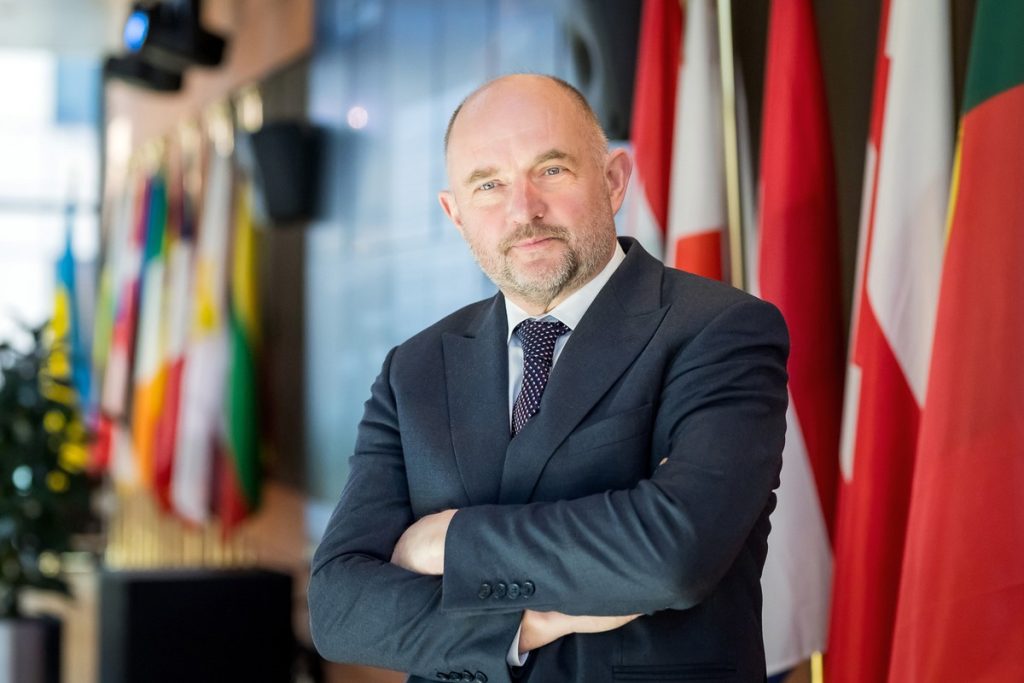
Rotating co-chairmanship of the Joint Commission: focusing on the regional perspective
Marshal Piotr Całbecki, who is attending today’s plenary meeting of the Joint Commission of Government and Territorial Self-Government (KWiRST) in Warsaw, is assuming the rotating co-chairmanship of the body on behalf of the local and regional government side. The Commission serves as the principal platform for dialogue between central government and local and regional authorities. Today’s agenda includes a comprehensive package of healthcare-related issues and a presentation of our regional programme for combating domestic violence over the next five years (2027–2031).
“Taking on this role means assuming responsibility for representing the interests of the entire local and regional government sector – regions, counties, cities and municipalities. The aim is to ensure that the experiences and needs of all tiers of self-government are taken into account in discussions on the direction of national policy,” emphasises Marshal Piotr Całbecki, who previously co-chaired the Commission in 2020.
By bringing a regional perspective to the Commission’s work, Marshal Piotr Całbecki intends to draw its attention to issues that are crucial to the future and development of Poland’s regions. One of the most significant challenges today is the future of EU cohesion policy and the financing of regional programmes – and regional development in its broadest sense – beyond 2027. Preparations for the European Union’s new financial framework (2028–2034) have sparked intense debate not only about the size of the EU budget but also about the principles governing the allocation and management of funds.
Another important issue is the future of the EU’s Common Agricultural Policy and its relationship with cohesion policy. The shape of the new European budget will have a direct impact on opportunities to finance regional development, including the development of rural areas. For regional authorities, it is essential to maintain adequate funding for both economic and infrastructure development and the reduction of development disparities.
In their relations with central government, local and regional authorities have long emphasised the need for a stable and predictable legal framework. This also means ensuring that the government provides adequate funding for the responsibilities entrusted to them. Equally important is the meaningful involvement of local and regional government representatives in drafting new legislation, so that their experience and perspectives are taken into account from the earliest stages of policy development.
Security is becoming one of the most pressing issues requiring cooperation between central government and all tiers of local and regional government. The current geopolitical situation is placing increasing emphasis on crisis resilience, civil protection and preparing infrastructure to withstand emerging threats.
Department of Strategic Planning and Regional Cooperation
and the Press Office of the Marshal’s Office
25 November 2026