


No Irregularities Found, Inspection Results Pending
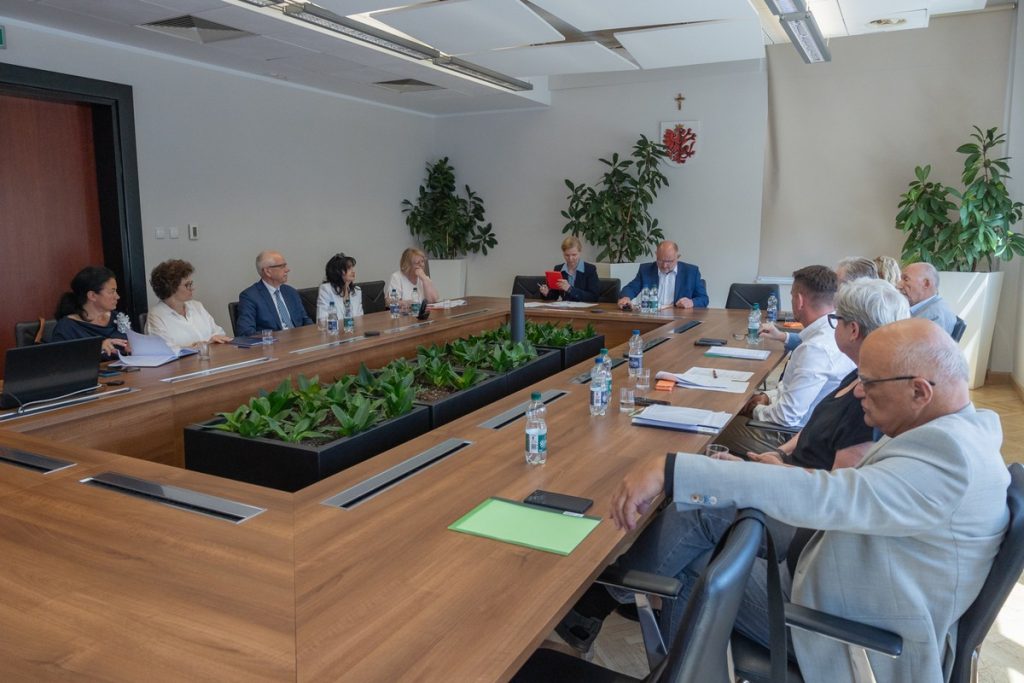
Marshal Piotr Całbecki met with the directors of all seven hospitals operated by the Kujawsko-Pomorskie regional self-government at the Marshal’s Office on Tuesday (14 July). The meeting focused on regulations governing the employment and remuneration of physicians, staffing arrangements for emergency departments (EDs), as well as ongoing and planned inspections at the region’s healthcare facilities. An extraordinary session of the Regional Parliament will be held on Thursday, during which the Marshal will present information on the current situation in the region’s publicly owned hospitals.
The meeting was attended by Professor Janusz Kowalewski, Director of the Oncology Centre in Bydgoszcz; Edward Hartwich, Director of the Regional Children’s Hospital in Bydgoszcz; Sylwia Sobczak, Director of the Regional Integrated Hospital in Toruń, together with the hospital’s Chief Medical Officer, Professor Marek Jackowski; Dariusz Szczepański, Director of the Regional Specialist Hospital in Włocławek; Dariusz Rutkowski, Director of the Regional Mental Health Hospital in Świecie; Mariola Brodowska, Director of the Kujawsko-Pomorskie Centre of Pulmonology; Grażyna Welter-Zamroczyńska, Director of the Regional Infectious Diseases Hospital; and Agnieszka Lisek-Charkiewicz, Director of the Health Department at the Marshal’s Office.
“We discussed issues that are currently of concern to both the public and the medical community in our region. The key question is how effectively our hospitals, including the Regional Integrated Hospital in Toruń, are fulfilling their mission. Based on the inspections carried out so far, both recent and earlier ones, we have found no irregularities, including in the emergency departments. All inspections conducted to date indicate that these units are operating properly,” Marshal Piotr Całbecki said after the meeting.
The participants reviewed in detail the operation of the Regional Integrated Hospital in Toruń, with particular attention to its emergency department. According to information presented by the hospital management, medical staffing levels are adequate. The department is permanently staffed by two emergency medicine specialists (while only one is required under current standards) and between five and seven physicians from other specialties. The emergency department treated 41,000 patients last year and more than 21,000 in the first half of 2026 alone. Only 30 per cent of these patients required hospital admission, while around half underwent advanced diagnostic procedures, including medical imaging, within the emergency department.
The meeting also addressed the case of a resident physician from the Regional Integrated Hospital who appealed a disciplinary reprimand issued after he failed to comply with an official instruction. The instruction concerned an intervention in the emergency department. Instead of attending to the patient immediately, the physician arrived several hours later.
Another important topic was physicians’ remuneration. Salaries in the region’s hospitals are broadly in line with national averages across the public healthcare system and are generally appropriate to the realities of healthcare financing in Poland. There are a small number of exceptionally high salaries, but these relate to leading specialists, primarily in oncology, who voluntarily work well beyond the standard eight-hour working day in order to fulfil obligations arising from Poland’s oncology care programme and ensure patients receive timely, life-saving treatment.
“The cost of employing highly qualified specialists is also closely linked to investments in advanced medical equipment. State-of-the-art medical technologies require top-class professionals to operate them. It should also be remembered that the regional self-government manages highly specialised, tertiary-level hospitals that employ some of the country’s best medical professionals,” Marshal Piotr Całbecki emphasised.
The Regional Integrated Hospital in Toruń is currently subject to four inspections conducted by the National Health Fund (NFZ), the Kujawsko-Pomorskie Voivode, the Patient Ombudsman, and the National Labour Inspectorate. According to the information available to the regional government, none of these inspections has identified any irregularities so far. Final inspection reports are not expected before October.
Among the conclusions of Tuesday’s meeting were the need to revise the rules governing the composition of hospital supervisory councils, with each council to include a substantive representative of the Marshal of the Region, and the obligation for hospital management to promptly inform the Marshal’s Office of staffing shortages, the suspension, merger or closure of hospital wards, and complaints concerning the organisation and operation of healthcare facilities.
Beata Krzemińska
Spokesperson of the Marshal’s Office
14 July 2026
Last updated: 15 July 2026