

School Can Be Fascinating
An interview with Magdalena Popielewska, Headteacher and vocational subject teacher at the J. Gagarin School of Construction in Bydgoszcz, and Anna Pędzich-Kuszel, Biology teacher at the Jan Kasprowicz First Upper Secondary School with Bilingual Classes in Inowrocław – two of the five recipients of this year’s Kujawsko-Pomorskie Education Leader Award.
You have been awarded the title of Professor of Education. Is it still worth investing your own time in pursuing professional advancement within Poland’s education system?
Anna Pędzich-Kuszel: – It is definitely worth it, although the answer is not as straightforward today as it once was. The time devoted to school – the extra hours that go far beyond the timetable – is about much more than preparing tests and marking them. It is about building relationships, which are the foundation of education. It is worth doing because the relationship you build with a young person, and the moment when you see a spark of understanding in their eyes or realise that they feel someone believes in them, are invaluable. I have experienced this many times – in lessons, during extracurricular activities, when accompanying students to academic competitions, and when helping them work through various problems. I know very well how important my presence in all these situations has been, and continues to be, to them. It is these additional moments that build trust, without which we cannot truly reach a student.
For me, the title of Professor of Education is not only the crowning achievement of my career, but also a commitment to remain there for students and stand by them, and to show that school can be fascinating. On the other hand, we must acknowledge that schools are currently facing a crisis of authority and struggling with systemic problems. But it is we teachers – passionate teachers, teachers who take pride in their craft – who create a safe space for young people. If we devote this time exclusively to routine, school will become a very cold institution, to put it mildly.
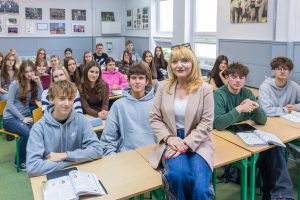
Anna Pędzich-Kuszel. Photo by Mikołaj Kuras for the Marshal’s Office of the Kujawsko-Pomorskie Region
The J. Gagarin School of Construction improves its position in the Perspektywy magazine ranking of technical secondary schools every year. What is the key to its success?
Magdalena Popielewska: – There is no single key. There are several: consistent work, a clearly defined direction for development and, above all, the people who build this school together. Our position in the Perspektywy ranking matters to us because it reflects the quality of education, examination results and our students’ achievements. We are delighted to have remained among the best technical secondary schools in Poland for years. It is a source of pride and confirmation that the path we have chosen is producing results.
However, I would not want to measure the school’s success solely by its ranking position. The community is equally important – people who can work together and identify with their school. This includes teachers who devote themselves to academic competitions, contests and projects, and who develop cooperation with universities and employers. It also includes students who want to do more than simply get good grades. I am particularly proud of their involvement in volunteering and charitable activities, through which they learn to recognise other people’s needs and take responsibility not only for themselves.
The ranking shows how good our school is in terms of educational performance, but it is the everyday life of the school that reveals what kind of people we are. Both dimensions matter equally to me.
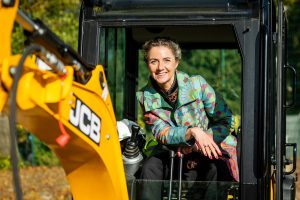
Magdalena Popielewska. Photo by Tomasz Czachorowski / eventphoto.com.pl for the Marshal’s Office of the Kujawsko-Pomorskie Region
What skills do students take with them when they graduate from the “Budowlanka” (School of Construction)?
Magdalena Popielewska: – I would like our graduates to leave with much more than a school-leaving certificate and vocational qualifications. Technical skills, precision, responsibility, spatial awareness and the ability to solve practical problems are, of course, fundamental. The construction industry is changing rapidly, so students learn about modern technologies, including those used in design. But there is another dimension of education that is particularly important to me.
I want young people to understand that they can use their skills not only in their future careers, but also to make other people’s lives better. That is why we involve them in renovating flats and houses belonging to people in need, and in helping those who are ill, lonely or facing difficult circumstances. The results of this work last for years, but what remains with the students themselves is just as important: the experience of helping others, empathy, respect and sensitivity to other people. It is a lesson that cannot be learned from a textbook alone.
I want our graduates to become skilled professionals who can find their place in the labour market, but also open-minded, responsible people who care about the needs of others. I would like them to leave the Budowlanka with two equally important assets: a good trade and sensitivity to their fellow human beings.
What values, apart from subject knowledge, do you try to instil in your students?
Anna Pędzich-Kuszel: – Knowledge becomes outdated faster than ever before. That is why what matters most is what stays with a person after they leave the classroom for the last time and graduate from school. I very much enjoy teaching through practical activities. I always remind my students of the importance of respecting others and showing empathy, of being able to see the world from the perspective of someone with a different sensibility, of thinking critically, and of having the courage to ask questions and express their own opinions – something that can be difficult these days. Responsibility for one’s words and choices is also important. I try to explain to young people that the consequences of our actions do not always match our expectations. We should not see this as a failure, but rather as a natural part of learning for the future. The ability to work in a team and take action for the benefit of others is equally important. It builds relationships and bonds, and gives us a sense of fulfilment.
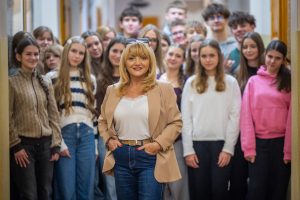
Anna Pędzich-Kuszel. Photo by Mikołaj Kuras for the Marshal’s Office of the Kujawsko-Pomorskie Region
Adults often say, “Young people today are different.” Would you agree?
Magdalena Popielewska: – Yes, young people today are different, but every generation differs from the one before it because it grows up in a different world. Technology, communication methods, access to information and the challenges young people face are all changing. However, I would not judge them in blanket terms. We often hear complaints about entitlement, shorter attention spans or difficulty accepting criticism, but it is worth first trying to understand where these behaviours come from.
I meet talented, creative and ambitious students who are highly socially aware. I see young people achieving success, pursuing their passions, working on projects and helping others selflessly. At the same time, we cannot ignore the challenges posed by social media. Young people are almost constantly connected, yet sometimes struggle to build close relationships in the real world. It is easier for them to send a message than to have a conversation, easier to watch than to participate, and the pressure to compare themselves with others can be really intense.
Our role as adults is not simply to criticise phones and social media, but above all to show young people that other possibilities exist. In my experience, young people need adults who take them seriously, set expectations, but are also able to listen and be genuine. We should not expect them to be like previous generations. Instead, we should help them find their way wisely in the world they live in and show them that genuine relationships and the satisfaction that comes from taking action also begin beyond the phone screen.

Magdalena Popielewska. Photo by Tomasz Czachorowski / eventphoto.com.pl for the Marshal’s Office of the Kujawsko-Pomorskie Region
Is it difficult to persuade “young people today” to study?
Anna Pędzich-Kuszel: – I teach biology at an upper secondary school, mainly in classes following a medical-oriented curriculum, with a focus on biology and chemistry, so I will speak primarily about my own subject. And I will say this plainly: it is no harder to motivate young people today to study than it was in the past. What has changed is that we need to motivate them differently. Today’s upper secondary school students need to see a real purpose in learning. They also look for authenticity and passion in what we do. When we show them the practical value of knowledge, provide good role models and demonstrate concrete applications, they can be incredibly engaged, curious about the world and creative.
The fact that we use different teaching methods today than we did thirty years ago does not mean that we should lower our standards or abandon high expectations. Quite the opposite – I continue to set high expectations. After all, these young people are preparing for their final secondary school-leaving exams, the matura, and want to achieve the best possible results so that they can get into the university courses of their choice. By meeting these expectations, they prepare for adult life. They learn responsibility and time management, and discover their own limits and capabilities. This process is called growth and maturity.
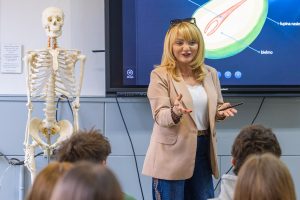
Anna Pędzich-Kuszel. Photo by Mikołaj Kuras for the Marshal’s Office of the Kujawsko-Pomorskie Region
What advice would you give to young teachers just starting out in the profession?
Anna Pędzich-Kuszel: – The early years in this profession can be difficult, and there is no secret about that. If I were to sum up the most important advice for those just starting out at school, I would point to several key principles. First, it is worth clearly setting out the rules that will shape relationships with students – young people really need clear guidelines. Authenticity is also hugely important. Students can spot insincerity straight away, so there is no point pretending to be someone you are not or being afraid to admit a mistake or a gap in your knowledge. On the contrary, such honesty does not undermine your authority; it builds a partnership based on discovering the world together. True authority grows out of mutual respect and fairness. It is equally important to establish clear boundaries from the very first months of work, so that you can protect your own well-being and personal space. Teaching can consume you completely, and school matters can easily spill over into your private life, like lava spreading across the landscape. When your work is your passion, maintaining that balance becomes an even greater challenge.
What do you value most about being a teacher?
Magdalena Popielewska: – I often think that I do not actually go to work. I have spent my whole life going to school. It is part of my life, my everyday routine, my emotions and my plans. I like getting things done, looking for new opportunities and taking on challenges. I find it difficult to accept that something cannot be done, so I get enormous satisfaction from seeing an idea that initially seemed difficult become reality.
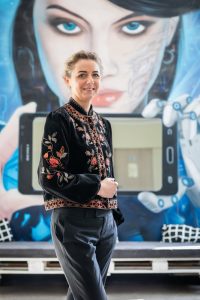
Magdalena Popielewska. Photo by Tomasz Czachorowski / eventphoto.com.pl for the Marshal’s Office of the Kujawsko-Pomorskie Region
The 2026 Kujawsko-Pomorskie Education Leader Award is a special distinction for me. I accept it with gratitude, but above all as recognition of the collective work of the entire Budowlanka community. What gives me the greatest satisfaction, however, is knowing that we have created a place with which people identify, a place they want to return to and speak of with pride – and from which young people leave not only with a profession, but also with the conviction that being a good person matters. This school still means a great deal to me. Quite simply, I love it.
See also: Meet the Education Leaders
Press Office, Marshal’s Office of the Kujawsko-Pomorskie Region
November 2026