


A Bydgoszcz – Toruń Roadmap Is Urgently Needed
An interview with Jan Wyrowiński, public figure, Vice-President of the Kaszubsko-Pomorskie Association, Vice-Marshal of the Polish Senate during its eighth term, and President of the Kaszubsko-Pomorskie Association from 1994 to 1998 and from 2019 to 2025.
In your view, are Bydgoszcz and Toruń making sufficient use of the development opportunities and potential offered by their close proximity?
To be honest, I am not aware of any serious analysis that precisely identifies the areas in which the close proximity of the two cities could foster their development and where the anticipated synergies might lie. Perhaps I have overlooked something. At one time, the concept of a Bydgoszcz – Toruń metropolitan area featured in national planning documents, and from Warsaw’s perspective there seemed to be good reasons for closer, perhaps even institutionalised, cooperation. Today, that idea seems to have become a thing of the past. Bydgoszcz first, and more recently Toruń, have been developing their own metropolitan areas, and serious consideration of the benefits of their close proximity seems to have been consigned to the back burner.
For me, a striking example of the squandered opportunities arising from Bydgoszcz being just around the corner was the fratricidal battle over the title of European Capital of Culture 2016. Let me remind you that Toruń’s bid was being taken very seriously. The then Minister of Culture, Bogdan Zdrojewski, told me quite openly that, in his opinion, Toruń would have been an ideal choice for the role. However, if a neighbouring city was unconvinced and submitted its own bid just a year before the final decision, that was an example of how everything could be wasted. We were unable to persuade Bydgoszcz to support our bid or to work towards submitting a joint one.
I remember that, towards the end of my time in parliament, I proposed establishing an interdisciplinary team of researchers from Nicolaus Copernicus University and Kazimierz Wielki University. Given the cities’ close proximity and the deep-seated mistrust and suspicion that accompany almost every attempt to strengthen cooperation – as illustrated by the long and difficult process of establishing the Collegium Medicum of Nicolaus Copernicus University in Bydgoszcz – such a team could continuously monitor and analyse various aspects of the region’s urban, demographic, economic and social development, focusing on opportunities to benefit from cooperation between the two cities. It would examine the metropolitan dimension and how best to harness the potential of Bydgoszcz and Toruń.
The idea was to ensure that we always had access to a reliable, objective, scientific assessment of the situation. Ideally, the team would bring together researchers from both Toruń and Bydgoszcz. Studies on the development of large, two-centre urban regions are already being conducted elsewhere, and their findings could be applied in our region. As I have said, I believe that objective analyses of this kind are lacking.
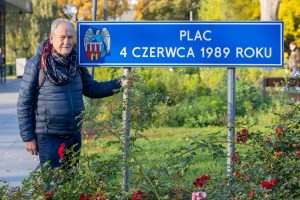
Photo by Mikołaj Kuras for the UMWKP
Would you therefore agree that the two capitals of our region are, in effect, still competing for the leading role in the region? What is behind this rivalry, and what might the consequences of such a policy be?
We need to bear in mind that there would be no Kujawsko-Pomorskie Region without its two-capital arrangement. This arrangement was the outcome of fierce rivalry, with divisions cutting across political parties and cooperation centred on concern for the standing of individual cities. Once Parliament had finally decided on the shape of our Region and the location of its centres of power, everyone should have joined forces and worked together to promote its development. The roles had been assigned, and that decision should have been accepted.
Of course, the role of [local] authorities is first and foremost to look after the interests of their own city, following the principle that “charity begins at home”. This concern was probably behind Bydgoszcz’s successful efforts to be listed separately in Eurostat statistics. I do not know what benefits this brings.
Unfortunately, I am a pessimist. The principle of “every city for itself” is practised by the authorities of both cities. The mutual suspicion surrounding their intentions does nothing to foster regional development, dissipates social energy and entangles decision-makers in fruitless disputes. For now, it is difficult to imagine a scenario that would bring about a change in the Kujawsko-Pomorskie status quo. However, the political landscape changes kaleidoscopically, and a time may come when growing rivalry between the two capitals becomes a reason to challenge it.

Photo by Mikołaj Kuras for the UMWKP
Can we identify any obvious benefits of closer cooperation between Bydgoszcz and Toruń than we have seen so far? What would need to happen to make this possible?
Someone – for example, the interdisciplinary team bringing together researchers from the two universities that I mentioned earlier – should prepare a SWOT analysis (strengths, weaknesses, opportunities and threats) of Bydgoszcz – Toruń cooperation and its impact on the development of the Region. Of course, such an analysis could just as well be commissioned from a reputable consultancy. At that point, both sides would need to demonstrate goodwill and agree to sit down for talks under the auspices of, say, the Marshal of the Region and the Voivode, in an attempt to agree on a possible joint action plan – a kind of Bydgoszcz – Toruń roadmap. If we let our imagination run wild, we could picture the mayors of Bydgoszcz and Toruń meeting for this purpose, perhaps not in Przysiek, which Bydgoszcz residents probably associate with unpleasant memories, but somewhere like Ostromecko. They would put aside old grievances and prejudices and begin talks. Joking aside, I cannot remember the last time Mayor Rafał Bruski visited Toruń, just as I cannot recall when Mayor Paweł Gulewski last visited Bydgoszcz.
There is, however, a glimmer of hope that the two mayors may soon meet, both in Copernicus’s city and in the city on the Brda River. After years away, Bydgoszcz speedway team Abramczyk Polonia has been promoted to the top division, and the local derbies lie ahead, providing an opportunity for meetings, including at mayoral level. Admittedly, every study of Bydgoszcz – Toruń animosities cites the rivalry between speedway clubs Apator and Polonia as an example of an occasion when mutual hostility among the two teams’ supporters comes particularly to the fore. Some have reduced the divisions between Toruń and Bydgoszcz to little more than this sporting rivalry. Unfortunately, the experience of recent years shows that the issue is far more serious.
26 October 2026