

Polish-Ukrainian House in Toruń
An interview with Tatiana Dembska, who runs the Polish-Ukrainian House in Toruń and the Dobro dla Dobra Foundation.
The Dobro dla Dobra Foundation was established in response to the outbreak of war in Ukraine. What is the scale of the assistance you provide today, and how have the needs of the people who come to you changed?
The Foundation was established when people fleeing the war in Ukraine began arriving in Toruń. At first, our focus was primarily on emergency assistance: food, clothing, hygiene products, accommodation, schools, doctors and help with documentation. We had to respond very quickly, because people often arrived with nothing more than a backpack and an enormous amount of fear.
Today, the needs are different. Material assistance is still important, but increasingly, the people who come to us need longer-term support: psychological, social, professional and language assistance, as well as help with integration. It is no longer just about surviving the first few days, but about building a life in Poland.
Over the years, the Foundation has grown significantly. We run the Polish-Ukrainian House, a Ukrainian library, a senior citizens’ club, counselling services, workshops and integration activities. What matters to me is that we are not simply a place where people come to “collect aid”. We are a place where you can come, ask a question, have a conversation and feel that you are not alone.
To date, more than 2,000 people have benefited from our support.
For the third consecutive year, we have been distributing more than 1,300 food packages.
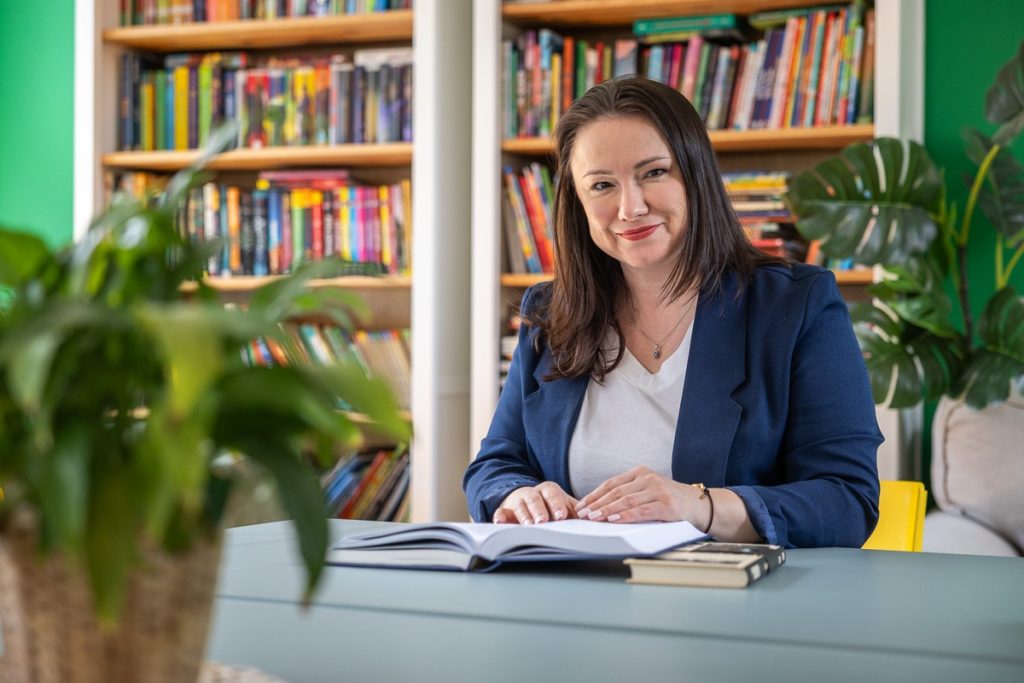
Tatiana Dembska, Photo: Szymon Zdzieblo/tarantoga.pl for the Marshal’s Office of the Kujawsko-Pomorskie Region
Providing help on this scale is an enormous emotional burden. What has been the most difficult aspect of this work for you over the past few years?
The hardest part was living under constant strain. Every phone call, every message and every person who walked through the Foundation’s door brought with them a story. Often a very difficult one. These were not anonymous cases, but real people who had suddenly lost their homes, their sense of security and the lives they had known.
The sense of responsibility was also very difficult. When someone comes to you for help, you want to do everything you can. But that is not always possible. There are not always enough resources, time or solutions. That feeling of helplessness could be incredibly difficult.
For me personally, the war in Ukraine is not a distant issue. It is my country, my language, my people. I had to act, organise assistance and support others while also dealing with my own emotions. I could always count on the support of many volunteers, both Polish and Ukrainian, who also listened to these difficult stories. Even today, hardly a week goes by without us hearing heartbreaking stories from families receiving devastating news from their war-torn homeland.
Over time, I came to understand that helping does not always mean doing something big. Sometimes the most important thing is simply that someone knows where they can go. That someone will listen to them. That, for a moment, they do not have to be alone.
What gives you the strength to keep going and makes you want to continue helping despite the difficulties?
People give me strength. Especially those moments when someone comes back and says, “Thanks to you, I made it through,” “I found a job,” or “My child feels safe.” Those are the words that truly stay with you.
The volunteers and all the people involved with the Foundation also make an enormous difference. Over the years, I have witnessed extraordinary solidarity – people who came after work, at weekends, often tired, but still ready to help. I am deeply grateful to the people of Toruń and to local businesses for that.
I am also motivated by the fact that I can see real change. We started with emergency assistance, and today we are creating a place for meeting, support and integration. The Polish-Ukrainian House, the library, workshops and the Senior Citizens’ Club – all of this shows that integration happens in everyday life, not just through projects and official documents.
We cannot fix the whole world. But we can make a real difference to individual people. And that gives me strength.
Tatiana Dembska, Photo: Szymon Zdzieblo/tarantoga.pl for the Marshal’s Office of the Kujawsko-Pomorskie Region
The Polish-Ukrainian House is a place for meetings, workshops and specialist support. What role does it play today in the local community, and who uses it most often?
For me, the Polish-Ukrainian House is above all a safe space. A place where you can come without feeling embarrassed or uncomfortable: to ask a question, talk to someone, seek help, meet other people or simply spend some time among people who understand similar experiences.
It is used primarily by people with migration and refugee experience, particularly people from Ukraine, but our activities are also open to residents of Toruń. Women, seniors, children, young people and entire families come here.
We organise workshops, meetings, consultations, educational and integration activities. The Ukrainian Library is an important part of the House. It is about much more than books – it provides a connection with language, culture and memories of home.
I want the Polish-Ukrainian House to be seen as part of Toruń. As a place that brings together people of different nationalities and with different life experiences.
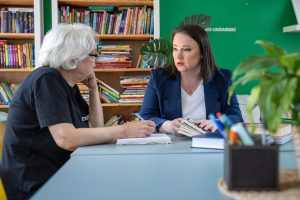
Tatiana Dembska, Photo: Szymon Zdzieblo/tarantoga.pl for the Marshal’s Office of the Kujawsko-Pomorskie Region
How, in your view, are Ukrainians adapting to life in Poland today?
Very differently. Some people have settled well in Poland: they work, learn the language, their children attend school, and their families are gradually building an everyday life here. I often admire their strength, because many of them had to start from scratch.
But there are also people who are still struggling. The language barrier, administrative formalities, access to healthcare, loneliness, homesickness and anxiety about loved ones in Ukraine – all of these challenges are still very much present. Many people are living, in a sense, between two worlds.
There is also a sense of social fatigue after the first wave of tremendous solidarity. That is why local initiatives that help Poles and Ukrainians get to know each other better are so important. It is easy to talk about a “group”; it is much harder to see the individual person and their story.
For me, it is important not to view people from Ukraine solely through the lens of war. They are people with skills, talents and enormous potential.
Some are still hoping to return home, while others no longer have a home to return to. Seniors face the greatest difficulties, as they have less and less support, and many of their homes and cities are now under occupation or have been destroyed.
I am encouraged by the stories of Ukrainians who are now doing well, starting their own businesses or moving into increasingly well-paid positions, which in turn improves their families’ quality of life.
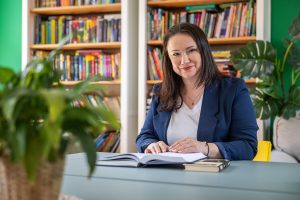
Tatiana Dembska, Photo: Szymon Zdzieblo/tarantoga.pl for the Marshal’s Office of the Kujawsko-Pomorskie Region
What are the Foundation’s and the Polish-Ukrainian House’s plans for the coming months?
We want to continue developing activities that respond to people’s real needs. We are not interested in projects for the sake of projects, but in support that genuinely makes a difference.
We will continue supporting people with migration and refugee experience, but we also want to do more to build a shared space for Toruń residents of different nationalities.
The Ukrainian Library is particularly important to us. We want it to be more than a place where people borrow books – we want it to become a space for culture, meetings and conversations about language, literature and identity.
We are particularly focused on empowering women, supporting entrepreneurship, language learning and strengthening independence. We want women to develop their skills and create a space where they can pursue their personal and professional development goals at as little cost as possible.
My dream is for the Dobro dla Dobra Foundation and the Polish-Ukrainian House to become a lasting part of Toruń’s social life – not only a place that responds to crises, but a place where community is built.
I would like the Dobro dla Dobra Foundation to show that helping people does not end with the initial emergency response. At first, you have to help someone survive. But afterwards, it is equally important for that person to regain their sense of agency, rebuild relationships and feel that they can once again build their own life.