

Interview with Sebastian Bartkowski
For many years, the Unisław Historical Society has been dedicated to researching and promoting the history of the Chełmno Land, Unisław, and the surrounding region. The Society publishes the periodical Unisław Historical Notebooks, organizes conferences, produces books and multimedia materials, and actively engages the local community. It also operates the Film Institute, which creates documentary films about historical events, particularly those related to the Second World War in Kujawy and Pomorze.
Now, the filmmakers have decided to venture further back in time by producing a docudrama about Nicolaus Copernicus, supported by the Kujawy Pomorze Film Fund. We spoke with the Society’s President, as well as the film’s screenwriter and director, Sebastian Bartkowski.
After making films focused on wartime tragedies, why did you choose such a different subject? Is it a welcome break from those difficult themes?
I think so – for the sake of mental well-being. Working on the horrors of war and the emotions surrounding those events eventually makes you feel it’s time for a change, at least for a while.
Does this mean you’ve finished exploring the Second World War, or might you return to it in the future?
I wouldn’t say never. We have plans for a ten-episode series. The first film is about Copernicus and the mysteries of his everyday life. I’m convinced that one of the later episodes will once again deal with the crimes committed in Pomorze. The topics will vary, and while many will be connected with our region, they won’t be limited to it.
Why Nicolaus Copernicus? It seems we already know everything about him.
That’s exactly the point – it only seems that way. There is still a great deal we either do not know or know only superficially. Many commonly accepted ideas are actually images preserved by tradition and repeated over centuries until they began to function as historical facts. As a result, numerous stories about the great astronomer’s life have become deeply rooted, even though their factual foundations are often weak – or sometimes nonexistent.
Everyone knows Copernicus because of his groundbreaking discovery. We want to show him as a man struggling with everyday life. He was involved in many different activities and dealt with the ordinary concerns of daily existence – things that very few people know about today. Stepping into his world is fascinating. Besides, Copernicus is closely connected with our region, especially Toruń.
Are you trying to build a monument to him or to demythologize him?
Our primary goal is to present him as a human being in his everyday life – a remarkable individual living within the rhythm of ordinary existence, with all its responsibilities and small daily concerns.
This approach did not come out of nowhere. We repeatedly heard that such a perspective was missing. Visitors following the Copernicus Trail, which stretches across the Kujawsko-Pomorskie, Warmińsko-Mazurskie, and Pomorskie Regions, often admitted that they knew surprisingly little about Copernicus as a person. They knew about his discoveries and understood their significance, but they could not answer simple questions: What was his daily life like? Who did he spend time with? What did he eat? What occupied him besides astronomy? Yet these are precisely the questions that spark genuine curiosity.
We are fortunate to enjoy complete independence in shaping this story. No outside institution dictates our interpretation. At the same time, we are fully aware of our responsibility. Our task is to remain as faithful to historical evidence as possible, maintaining the highest standards of accuracy and objectivity. There is no room for speculation or literary invention. Everything presented in the film is based on primary sources and extensive scholarly literature. My own background as a historian certainly helps in this respect.
Are there really enough historical sources to tell the story of Copernicus as a man?
Absolutely. They contain many fascinating aspects that remain virtually unknown to the wider public – for example, his financial disputes, his income, his relationships with women, friends and rivals, his everyday responsibilities, and what a typical day in his life might have looked like.
One particularly valuable source is the collection of approximately six thousand letters written by Bishop Jan Dantyszek. They reveal not only what was happening around Copernicus but also paint a vivid picture of the entire era. Through these letters we learn not only about the astronomer himself but also about the people with whom he interacted. They are extraordinarily valuable because they place Copernicus and those closest to him in a wide variety of contexts.
Do the sources reveal any more intimate details of his life?
Yes, although we do not want to give too much away. We are certainly not interested in cheap sensationalism. The issues we explore concern his finances as well as his personal relationships – especially those involving women. Even here, however, there are ambiguities: we are talking about one woman, or perhaps two, and the matter has never been conclusively resolved.
Equally fascinating are the people closest to him – Bishop Lucas Watzenrode, Alexander Scultetus, Tiedemann Giese, and Georg Joachim Rheticus, all regarded as among his closest associates. Their lives are so compelling that each could easily become the subject of a separate film.
Copernicus was a canon, which also made him an administrator and a public official. Will this aspect of his life also be featured in the film?
We would describe him as an administrator rather than a politician. He became involved in public affairs largely because of his uncle, Lucas Watzenrode, the Prince-Bishop of Warmia, but this was never his true passion. It was a duty he accepted and fulfilled, concentrating mainly on economic matters and monetary reform.
His real passion was astronomy. Whenever he had the opportunity, he devoted himself to observations and research. It would therefore be difficult to describe him as a politician in the modern sense of the word. Interestingly, during his own lifetime he was far better known as a physician. Numerous contemporary accounts, particularly those of bishops who sought his medical advice, confirm this. He was even summoned to Königsberg to treat Duke Albert of Prussia and consulted with some of the finest physicians of his day.
Today we remember him above all as an astronomer, but in Royal and Ducal Prussia he was primarily known as a doctor. His astronomical research remained largely unknown to his contemporaries, and even fewer people were capable of understanding its significance.
It is also worth remembering that canons belonged to the Church primarily in an administrative capacity rather than a pastoral one. In practice, only a small number of cathedral canons were actually ordained priests. In some chapters, only one or two members out of more than a dozen had received holy orders.
Will the film portray this reality?
Yes. We want to show what life was really like in those days and how different it was from the modern world. Yet despite the passage of centuries, human behaviour remains surprisingly familiar.
Money was always present in the background. What we would now call nepotism was then considered perfectly normal and raised little or no controversy. Networks of mutual favours, recommendations, and family connections formed the very foundation of public life. Copernicus himself became a canon thanks to his uncle, and later successfully sought to secure the same position for another member of his family.
Holding a canonry or benefice provided a stable and comfortable livelihood. Although administrative duties could be demanding, they also offered financial security and independence. It was precisely this stability that enabled Copernicus to devote himself to scientific research without worrying about making a living.
We also want to explain how this entire system functioned: what cathedral residences were like, how benefices worked, what allodial estates were, where the income came from, and how these resources were managed.
Will you address the question of Copernicus’s nationality?
Yes, although only briefly. The debate over whether Copernicus was German or Polish is largely a product of nineteenth-century nationalism.
In reality, the issue is far more complex than it is often presented. Copernicus left no surviving writings in Polish, while only two letters written in German are known. Everything else was written in Latin, which was the universal language of scholarship and educated communication. Polish was rarely used in such contexts. The wealthy patrician families of the Prussian cities – to which Copernicus belonged – generally spoke German.
Moreover, the very concept of nationality meant something entirely different in the sixteenth century. A person’s identity was determined primarily by political allegiance and loyalty to their ruler rather than by modern national categories. In that sense, Copernicus was unquestionably a loyal subject of the King of Poland.
You have also released an online film about the date of Copernicus’s birth.
That is another of the many mysteries surrounding his life. We devoted a great deal of time to investigating his birth date. Although 19 February 1473 is generally accepted, our research suggests that he may just as well have been born on several other dates.
What is particularly important is that no contemporary source conclusively confirms the accepted date. Essentially, the traditional date is based on astrological horoscopes. Unfortunately, the biography written by his pupil, Rheticus, has not survived. In the seventeenth century, Professor Jan Brożek of the Jagiellonian University assembled an impressive collection of source materials that he intended to publish, but those documents were subsequently lost. Ironically, despite his best intentions, this resulted in even greater gaps in our knowledge.
Even the exact date of Copernicus’s death remains uncertain. Historians point to different dates and even different places of death and burial. All of this makes him an elusive figure who continues to resist definitive historical conclusions – a true historical enigma.
One particularly intriguing thread concerns the search for Copernicus’s grave.
It is an extraordinarily fascinating – and at the same time highly mysterious – story, perhaps one of the most intriguing episodes in Copernicus’s entire biography. Efforts to locate his grave have continued almost uninterrupted since the sixteenth century, beginning with the initiatives of Bishop Marcin Kromer.
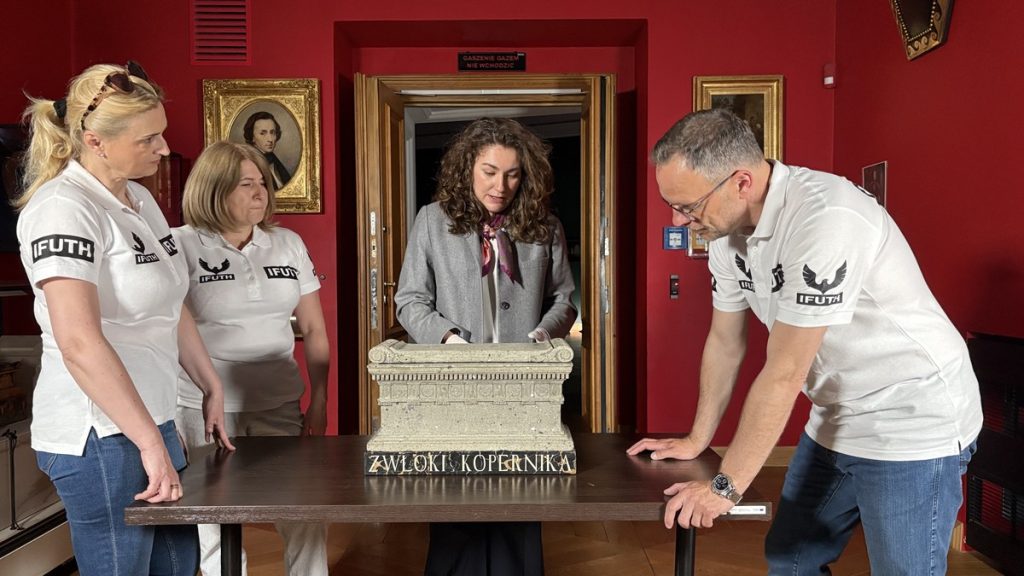
Over the following centuries, the search was pursued by, among others, the aforementioned Professor Jan Brożek, Napoleon’s officer Gérard Gley, and, in the early nineteenth century, Tadeusz Czacki, who believed he had discovered the astronomer’s remains in Frombork. Those remains are now housed in the Czartoryski Museum in Kraków. We were granted access to the mysterious sarcophagus bearing the inscription “THE REMAINS OF COPERNICUS” to see what it actually contains.
In the twentieth century, the investigation resumed. In 1939, a German archaeological team from Königsberg carried out excavations, opening several graves, recovering human remains, and even taking X-ray images of them.
The most widely known discoveries, however, are the recent ones. In 2005, Polish archaeologists began excavations aimed at identifying remains believed to belong to Copernicus, and they considered the project a success. Some scholars regard these findings as conclusive, while others continue to raise serious doubts. In the film, we also present the views of researchers who remain skeptical and explain the reservations surrounding these conclusions.
So this project involves not only archival research but also collaboration with experts?
Absolutely. We have assembled an outstanding team of specialists representing a wide range of disciplines, including history, church history, textual scholarship, archaeology, anthropology, and art history. Most of them are affiliated with the Nicolaus Copernicus University in Toruń: Professor Krzysztof Mikulski, Professor Janusz Małłek, Associate Professor Teresa Borawska, Professor Małgorzata Grupa, Associate Professor Tomasz Kozłowski, Professor Justyna Olszewska-Świetlik, and Professor Elżbieta Basiul. We are also working with Professor Andrzej Kopiczko from the University of Warmia and Mazury in Olsztyn, Professor Michał Kokowski from the Institute for the History of Science of the Polish Academy of Sciences, Associate Professor Anna Skolimowska from the University of Warsaw, and Dr. Jerzy Sikorski from Olsztyn.
We are equally pleased to receive support from a number of prestigious institutions, including the International Copernicus Research Centre, which brings together Nicolaus Copernicus University in Toruń, the Jagiellonian University, and the University of Warmia and Mazury in Olsztyn, as well as the Copernican Library in Toruń, the Copernicus House Museum in Toruń, the Nicolaus Copernicus Museum in Frombork, the Kujawsko-Pomorskie Heritage Centre in Toruń, the Kujawsko-Pomorskie Academy of Innovation, the Nostra Cultura Cultural Heritage Foundation, and the Museum of Warmia and Mazury in Olsztyn.
The film is being financed by the Marshal’s Office of the Kujawsko-Pomorskie Region, the City of Toruń, and the Toruń County Office. We have also received declarations of support from Chełmno, Włocławek, and Lubawa. Additional support has come from Ekochem and the Forum Oświata Trade Union Federation. We are currently in discussions with the Marshal’s Office of the Warmińsko-Mazurskie Region.
Copernicus travelled extensively and lived in many different places throughout his life. Where will the film be shot?
The production will have a remarkably broad geographical scope. The dramatized scenes will be filmed in Toruń, Frombork, Lidzbark Warmiński, Olsztyn, Morąg, and Bierzgłowski Castle. Additional filming will take place in Kraków, Warsaw, Uppsala, and Strasbourg.
Do we actually know what Copernicus looked like?
Once again, we are dealing with another mystery. We travelled to Strasbourg specifically to examine one of the oldest surviving portraits of Copernicus. The renowned artist Tobias Stimmer painted it on the basis of a self-portrait that no longer exists. There are several other enigmatic portraits as well – but I’ll leave it at that.
We also travelled to Uppsala in Sweden to see the books that once belonged to Copernicus’s personal library and were taken there during the Swedish wars. On the one hand, it is difficult not to regret that they are no longer in Poland. On the other hand, paradoxically, it may be precisely because they left the country that they have survived to the present day.
We wanted to examine them closely and look for small but revealing details – marginal notes, handwritten annotations, and sketches. These seemingly insignificant traces allow us to see not merely the scholar, but the man himself.
I heard that cat hairs were found in those books, leading to the conclusion that Copernicus owned two cats.
Various hairs were found in those books. Who they belonged to… I don’t think anyone can say with certainty.
It is no secret that there was a woman in Copernicus’s life. I assume that will also be part of the film.
Of course. There may even have been two. One of them was Anna Schilling. There is no doubt that she played a role in Copernicus’s life. The real question is: what exactly was that role? Based on the surviving sources, it is extremely difficult to give a definitive answer.
This is an area where it is all too easy to fall into extremes, which is particularly dangerous, because virtually every interpretation can be supported by the same body of evidence. Our aim is to maintain balance and remain as objective as possible.
Another challenge lies in the language of the sources themselves. Every document relating to this issue was written in Latin. In translation, even a single word can carry enormous weight and completely alter the meaning of a passage.
This leads to yet another mystery: Was Copernicus actually a priest? Did he receive holy orders? If so, which ones? These questions remain unanswered to this day.
And then there is the story of his brother…
His brother?
Yes. We also explore the life of his brother, Andrew Copernicus, and their remarkably interesting relationship. What happened to him? Why do historians hold such different views about his life?
For many years, historians believed that Andrew was older than Nicolaus. More recent research strongly suggests that he was, in fact, the younger of the two brothers.
Andrew’s life is every bit as colourful and intriguing. For many years he lived in Italy as a canon of the Warmian Cathedral Chapter. He also struggled with a terrible and deeply stigmatizing illness…
But I don’t want to reveal too much. His story will unfold in the film itself.
At what stage of production is the film now? When can audiences expect to see it?
In fact, part of the filming has already been completed. Last autumn, we recorded an interview with Dr. Jerzy Sikorski, one of the foremost experts on Copernicus’s private life.
The dramatized scenes are still ahead of us, but preparations are now gathering pace.
More than five hundred people applied to take part in the casting process. We are genuinely delighted by such tremendous interest, especially because so many people have volunteered to participate without financial compensation. The work on set is entirely community-driven.
For the time being, we prefer not to disclose the detailed production schedule, but we can already reveal one important date.
We are planning the premiere for 19 February 2027 – the symbolic date traditionally regarded as Copernicus’s birthday.
We regularly share updates on the progress of the production through the Film Institute of the Unisław Historical Society’s Facebook page.
One major difference compared with your previous productions is that this time well-known actors will appear in the film.
We’re absolutely thrilled about that. The role of Nicolaus Copernicus will be played by Mariusz Drężek, a stage, film, and television actor known for numerous productions. The female lead opposite Copernicus will be portrayed by Aleksandra Popławska, while the role of Canon Felix Reich will be played by the legendary actor Lech Dyblik. We are very much looking forward to working with all of them.
When we spoke about your previous films, you mentioned searching second-hand shops for costumes. That obviously won’t work this time – sixteenth-century clothing isn’t exactly easy to find.
Exactly – and that is one of our greatest logistical challenges. We are working with historically accurate costumes, prepared with the support of historical re-enactment groups. The entire costume design is supervised by Professor Małgorzata Grupa of Nicolaus Copernicus University in Toruń, who serves as our historical consultant, ensuring that everything remains faithful to the period and free from the inaccuracies that so often appear in historical productions.
Then there is the entire production infrastructure: sets, furnishings, and props, all of which require an enormous amount of work. Adding to the challenge, part of the filming takes place in Warmia, which means major expeditions for our team. We have already visited all of the planned locations, and we are deeply grateful for the warmth and hospitality we have received everywhere.
This is a completely different kind of filmmaking from commercial productions. In commercial projects, everything operates according to contracts – you pay for services and expect specific results. Here, everything is built on trust, cooperation, and the goodwill of people who share our passion. That gives the project a truly unique character. It is worth remembering that our team consists of dedicated enthusiasts, not professional filmmakers or members of the commercial film industry.
Does anything still surprise you during the production?
Constantly. For example, the Museum of Warmia and Mazury has received funding for extensive renovation work on Cathedral Hill in Frombork and at Olsztyn Castle – possibly during exactly the period when we plan to shoot there. There are countless variables that can complicate the logistics of a project like this, and we have to adapt to them as they arise.
And finally, I have to ask: was Copernicus a woman?
(Laughs.)
That question has already been settled beyond any doubt. The question of the presence of a woman – or perhaps women – in Copernicus’s life, however, is something we will examine thoroughly, objectively, and with the seriousness it deserves. It remains one of the most intriguing aspects of his biography, even for scholars who have spent their careers studying him.
Thank you for the interview.
Department of Promotion
Paweł Jankowski