

Cinema Has Changed Terribly. An Interview with Grażyna Szapołowska
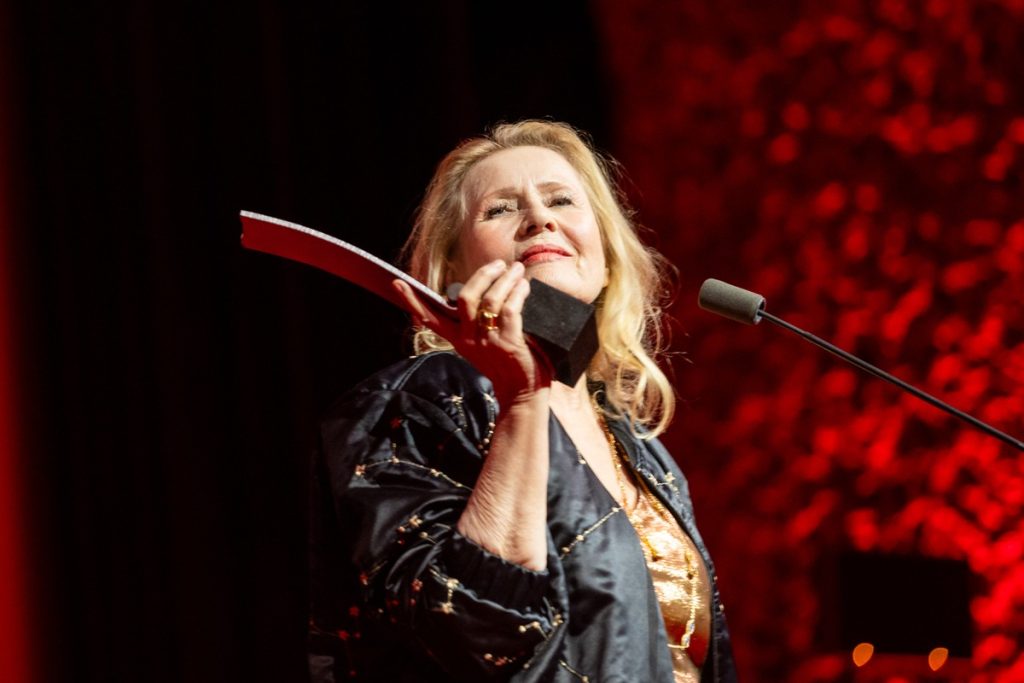
Now I would rather be a director or a producer. It is very difficult to say something that will touch the viewer, says Grażyna Szapołowska, winner of the 2025 Film Award of the Marshal of the Kujawsko-Pomorskie Voivodeship.
Did the years when you attended school in Toruń influence you as a future actress?
It was not the years that had an influence, but the architecture of Toruń and the countless cinemas to which I would escape, skipping geography classes. Mr Wacław Tywoński was the tutor of my year, and he would always mark me as present. He would say: Grażyna is at the cinema, I forgive her. I went to the Wolność, Echo and Orzeł cinemas. I simply went to the cinema all the time. Whenever I was bored with a subject, I would run away and watch films. Back then, in the 1960s and early 1970s, films such as Bergman’s The Seventh Seal, Wild Strawberries and Rio Bravo were being shown. The repertoire consisted of such wonderful films that I learned from them. There really were many cinemas in Toruń, and they screened films that nowadays only reach arthouse cinemas, because multiplexes do not show them at all.
Yes, but the world is moving in such a bad direction, towards a rush of randomness. Because time seems to be spinning faster, and everything around us is spinning faster, we are no longer able to stop and focus on one problem in order to feel that we are alive. This is an incredible mistake of civilization. It seems to me that time is racing faster, that the Earth is spinning faster, and for example people often say to me: You do not look your age. That is because I feel I am not as old as I am. Time has made me that age, but in truth I am not, because it is passing too quickly. Cinema has changed terribly.
Times have come when, for someone casting a film, the number of Instagram followers matters more than achievements and talent.
But that is normal, and it has been like that from the very beginning. Polish and foreign directors cast stars who were known and had recognizable names. It was the same with Krzysztof Kieślowski, who, once he had gone beyond our borders and Paris in particular had become fascinated with him, wanted only Juliette Binoche, he wanted Trintignant, he wanted actors who would bring him even greater publicity. That is natural and understandable.
I would also look at it that way if I were producing a film. Of course, I would see it a little differently, because I would look for real talent that could blossom. Most producers look at names, exactly as you said, at the number of Instagram followers, whether it pays off, how many scandals there are. This mainly concerns advertising, but also feature films and cinematography in general. Brad Pitt and Angelina Jolie — huge scandals, divorces and so on — their fees rise day by day precisely because of that. Here he advertises coffee, there he advertises a bank without saying a single word, because he is Brad Pitt. So it is about building an image. Of course, that image began with one of his first films, Thelma & Louise, in which he played a lover, such a wonderful cowboy. Every one of us started with a bed scene. Brad Pitt did too.
That publicity grows, then the actor becomes great, practically inaccessible, and dictates the conditions under which he would like to act. Elizabeth Taylor began in black-and-white films. She appeared in the comedy Father of the Bride with Spencer Tracy — she was very young then, and only later was her talent noticed. Then came Cleopatra, Who’s Afraid of Virginia Woolf? and so on. She became more and more expensive and more and more desirable. And she was desired because she was real, because when she acted, she truly acted, and that is an incredible truth that touches people. On the other hand, the texts and plots carry what touches people — lies, betrayals, murders, love. Since ancient times, these have been the themes that move humanity. Humanity may seem ordinary, but each of us carries some mystery within us that would be suitable for a film, although everyone is afraid to reveal it. When they do reveal it, it turns out to be uninteresting, so one has to look for something interesting. Americans say that if there are no guns, women and horses in cinema, then there is no cinema. Wajda had something of that too, because he loved horses and animals, although he did not like animals and children on set. Wisława Szymborska was once asked by a journalist whether she liked children — he probably wanted to tease her because she did not have any — and Ms Wisława replied that she did, but not the ones who appear in commercials.
There is a saying that, in fact, everything has already been said in ancient dramas.
Yes, but the costume and the scenography change. In truth, it is all the same, only in a different setting. Yes, what you said is true. It is as if humanity had stopped at a certain stage in the multitude of experiences in life: either one loves or does not love, kills or does not kill, steals or does not steal, commits adultery or does not. So Kieślowski’s Decalogue appears. Everything happens around those Ten Commandments, every story; the one above did not invent anything more.
You have acted in films by outstanding directors. Is there any one of them whom you value particularly highly?
I would single out Andrzej Barański’s Tabu, because I was very young and played a very serious, difficult and dramatic role. And with a wonderful director. I like Kieślowski’s A Short Film About Love and No End, I like Károly Makk’s Another Way, Filip Bajon’s The White Visiting Card, Saniewski’s Supervision, and the role of Telimena for Andrzej Wajda. He wanted to offer me the role of Laura in The Spring to Come. He wrote about it in his memoirs. My heart broke, because we no longer had the chance to meet.
Many actors feel the need to stand on the other side of the camera.
Now I would rather be a director or a producer. It is very difficult to say something that will touch the viewer, because we look at life through scenes and effects, while the script and the making of an entire film are a very strong construction.
What kind of way of guiding an actor do you like in directors? Those who say exactly what they want and how the role should look, or those who allow room for one’s own interpretation?
It has to be preceded by conversations, not necessarily about the role, but about life in general. It is about getting to know another person. Just as you are now looking at me very sincerely, I could infer many things by talking with you. It is the same with a director. If he is curious about the life of the person he wants to invite into his project, then it is based on conversations. I had that with Károly Makk, mainly with Krzysztof Kieślowski, and with Filip Bajon. His conversation was brief. He said: Grażyna, you have to dye your hair dark. And that gave me so much, it changed so much in the way I looked at myself, at what he wanted to achieve, what kind of eroticism, what kind of scandal in The White Visiting Card. It was incredible. A conversation with the director is important, very important. Otherwise, the coffee does not taste good.
Promotion Department
Paweł Jankowski
9 July 2026