

Tofifest Is Great Fun for Me
An interview with Kafka Jaworska, Director of the BellaTOFIFEST International Film Festival.
Where did the idea of organizing a major film festival in Toruń come from?
The idea emerged quite spontaneously. I believe that the most wonderful moments in life are those when something happens that changes it forever in a positive way. One day, I received a phone call asking whether I would like to organize a film festival. Standing there with my young child in my arms and writing my master’s thesis on the cinema of Krzysztof Kieślowski, I made a decision that shaped my entire professional life. It had never been my dream, nor had I planned such a career. An extraordinary opportunity simply knocked on my door, and I accepted it. Even today I sometimes find it hard to believe this story – it feels almost like a fairy tale that turned my life upside down, made me fall in love with what I do, and has stayed with me ever since.
The beginnings are never easy.
Let’s be honest – in those days the festival’s budget was practically zero. It was organized by the Dom Muz cultural centre at its Podmurna Street branch. A small team of wonderful people and friends worked on the festival in a tiny office. At that time we presented what was known as off cinema – a branch of filmmaking that no longer really exists in the same form – focusing mainly on short films. The whole process was remarkable: selecting films at home from VHS tapes and screening them from 35 mm film prints. Later, the film industry underwent an extraordinary transformation, and I gained invaluable experience. It became clear that Toruń needed culture – film culture in particular.
What has changed over the past almost twenty-five years?
The turning point came in 2005, when the Polish Cinematography Act was passed and the Polish Film Institute (PISF) was established. That was a breakthrough because, before such an institution existed, public funding for the audiovisual sector – including film festivals, producers and directors – was virtually impossible.
The creation of the Polish Film Institute revitalized the industry. It was a landmark moment that enabled our festival to grow. I could list changes endlessly. Technology has changed enormously, to begin with. We no longer need to be incredibly strong just to carry film prints. Back then each print weighed around 20 kilograms and came packed in huge metal containers. You needed a strong back.
Funding opportunities have also expanded considerably. I always say that the two pillars of civilization are culture and education. Buildings may one day disappear, but culture defines who we are. Film, in particular, is an enormous intellectual and organizational challenge. It requires expertise, talent and the right personality. Organizing a film festival – or culture in general – involves tremendous risk, but I genuinely enjoy it. It has taught me to anticipate problems and given me the inner strength to keep looking for solutions, even when everything seems to be falling apart, instead of simply worrying.
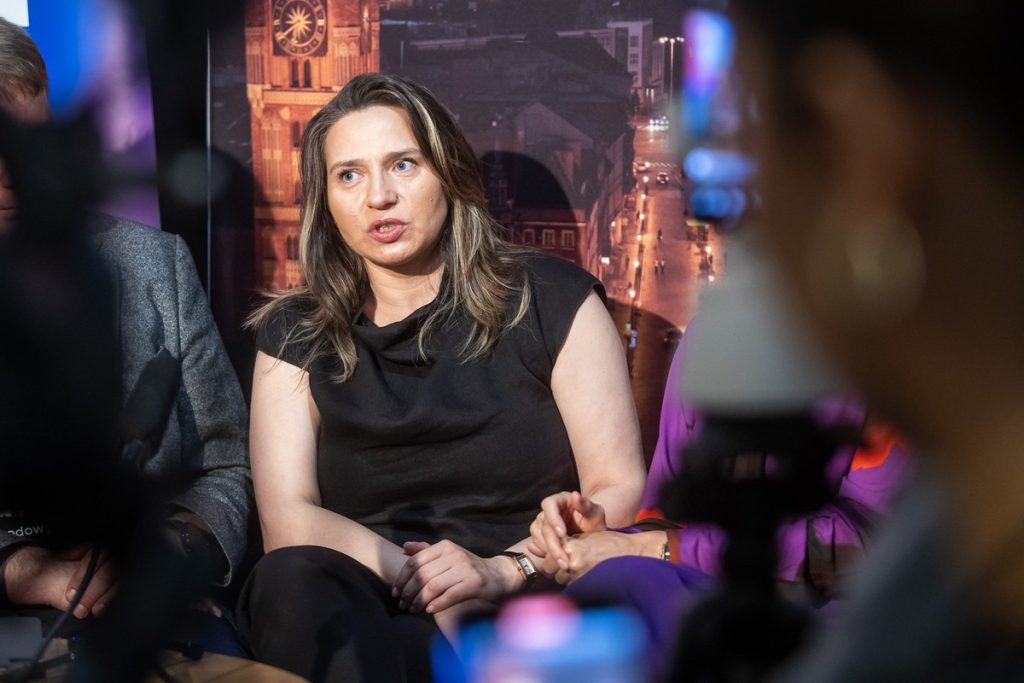
Kafka Jaworska, photo by Szymon Zdziebło/tarantoga for UMWKP
How has the festival itself evolved over the years?
It has grown in every possible way. It has become longer, the number of screenings has increased, its name has changed, and the dates have been adjusted to fit Toruń’s cultural calendar. The budget has also grown, which is essential because inflation affects everything – from film print licensing fees to travel and airline tickets. We’ve changed our profile, our name and our screening venues.
Is there one achievement that stands out in your memory, something you’re particularly proud of?
I’m actually rather critical when I look back. I prefer drawing conclusions that help me improve rather than dwelling on past achievements. Perhaps that’s my greatest flaw – I strive for perfection, even though I know it’s unattainable. I tend to focus on the future rather than admire what I’ve already accomplished. Of course, I could sit down and list our successes, but I simply don’t feel the need. I don’t need self-promotion because those who love our festival already know the quality of the work we do. Anyone who loves cinema and wants to meet artists – not “stars,” because they’re people, not celestial bodies – already knows our story and eagerly counts the days until the next edition of the festival.
These days the word “star” is used rather loosely.
Indeed. Today a “star” can also be an influencer or a celebrity chef hosting a cooking show. I’m not criticizing that. I think it’s largely driven by the needs of tabloid media and the race for clicks. We live in an incredibly fast-paced world. People skim headlines instead of reading in depth, and we’re overwhelmed with information. We understand that reality, but we choose a different approach. Every year we build a narrative around a central theme. We want to encourage audiences not only through famous names – although they certainly matter – but through the stories behind those people. Every artist we invite has a unique story, a body of work and genuine talent. Being famous doesn’t necessarily mean being talented. That’s why we always refer to them simply as artists.
Is it difficult to persuade filmmakers and actors to come to Toruń? Do you have to convince them?
Not really. The festival has been around for almost a quarter of a century – which certainly sounds respectable – so we’re no longer newcomers. We are very well recognized, especially within the European film industry, which is our natural environment. The main challenge is usually finding dates that suit everyone’s schedule. Honestly, I have never encountered anyone saying they didn’t want to come to Toruń. It makes us very happy – especially since we’ve become friends with many of them – when they tell us they can’t wait to come back and see us again.
Do people ever say, “At last you’ve invited me”?
That happens too. But we have to remember that every festival has its limits, including financial ones. Toruń also has a finite hotel capacity. We organize the festival during the peak tourist season, which is wonderful because our audience becomes very diverse. It’s not just film professionals who attend, but also tourists and local residents. At that time of year, the city comes alive not only with cafés but also with the high-quality cultural programme we offer.
As you mentioned, the festival began in the era of VHS tapes, while today we live in the age of streaming.
I remember that we started with just 20 films. Today our programme includes more than 120 titles. At first we focused exclusively on Polish short films. Nowadays feature-length films, especially fiction, make up the core of our programme. That said, we have never abandoned documentary cinema. We dedicate documentary sections to specific themes, each curated by specialists. Our programme now features not only Polish premieres but also European premieres, which is extremely important to us. We closely follow the catalogues of streaming platforms because the entire audiovisual industry has changed dramatically, especially after the pandemic, when streaming became a natural part of everyday life. I honestly don’t know anyone who doesn’t use streaming services now. Still, I believe that one medium supports the other. And artistic European cinema will always prevail.

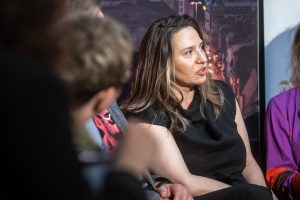
Kafka Jaworska (left) during the press conference before Tofifest 2026, photo by Mikołaj Kuras for UMWKP
Film festivals are the perfect place to showcase it.
Film festivals experienced a brief slowdown after the pandemic because we all stayed at home for well over a year. But festival tourism has returned. People once again want to travel, attend festivals, catch up on films they’ve missed and discover new works. Cinema theatres simply cannot screen every outstanding production, and there are many remarkable films that never receive the attention they deserve. Festivals exist to bring those films together and present them to audiences.
How does the film selection process work today? What determines whether a film makes it into the programme?
The selection process works in three ways. First, we use online submission platforms – one international and one Polish – through which filmmakers submit their productions. Second, after so many years of organizing a festival devoted to ambitious, auteur and lesser-known cinema, we know the international distribution market extremely well and can actively seek out interesting titles ourselves. For example, we often have access to films selected for the Cannes Film Festival even before their official screenings take place there. Third, we work with curators responsible for individual programme sections. They make their selections in consultation with me, and ultimately, I make the final decision.
What surprises do this year’s curators have in store for audiences?
This year we are introducing a new section entitled “From a Different Perspective.” It is curated by film journalist and critic Aleksandra Salwa, a member of FIPRESCI (the International Federation of Film Critics), who specializes in Middle Eastern cinema. She will introduce audiences to a completely different side of that region through a selection of new and surprising films.
We also have a curator for the Polish Competition, Łukasz Maciejewski – a film critic, journalist and writer – and Artur Zaborski, Vice-Rector of the Warsaw Film School and a film critic, who curates the “Rebels” section.
That last section seems especially close to your heart.
For years, BellaTOFIFEST has been defined by the spirit of rebellion and independence. Regardless of the social, political or artistic climate, that independent spirit always proves its value. It is the foundation of our festival. We create an event that consistently and courageously addresses difficult subjects and important social issues. But we also insist that both the artistic quality and the cinematic form remain of the highest standard.
This year the festival includes the retrospective “The Actresses of Andrzej Wajda,” curated by Łukasz Maciejewski. Why present Wajda’s work through the women in his films?
This is the Year of Andrzej Wajda, and I happen to share the same birthday as he did, so I have always felt a special connection with one of the greatest filmmakers in cinema history.
For a long time I wondered whether we should honour him, since I assumed many film festivals in Poland would mark the centenary of his birth. Then a film critic friend of mine wrote an excellent article arguing that Wajda’s actresses had never truly received the recognition they deserved.
I called him and asked what he would think if I built a festival section around that idea. He replied, “Only you could come up with something like this – it’s brilliant.” Since our festival has always promoted women artists – both through the stories told on screen and through the women who create films – the theme “The Actresses of Andrzej Wajda” felt like a perfect choice. The section will be a retrospective accompanied by appearances from actresses who worked with Wajda and who will share their memories during a special discussion. I won’t reveal any names just yet, but it will undoubtedly be one of the most important events of this year’s festival. We are organizing it in cooperation with the Polish Film Festival in Gdynia.
An outdoor cinema is a very interesting festival idea. Where will you be inviting audiences this year?
At the festival, we showcase the latest productions as well as classics; cinema that is a bit heavier and more challenging, but also lighter fare. On top of that, we have our outdoor screenings. The outdoor cinema is a vital part of the festival. This year, we are adding another location, bringing the total to four. As a reminder, screenings take place in the garden of the Burgher’s Court (Dwór Mieszczański) and in the courtyard of the Old Town City Hall (Ratusza Staromiejskiego). Three years ago, we ventured outside the Old Town and started operating in Mokre, in the industrial area of the Bumar Center. We were worried about whether this location would catch on, but it turned out to be a fantastic success. Residents gladly come out of the nearby apartment blocks to watch a movie. This year, for the very first time, we will also visit the Ethnographic Museum, where audiences will be able to see a wide spectrum of cinema, from older productions to the latest releases.
I’ve always been curious about the festival’s name, which sounds quite sweet. Where did Tofifest come from?
Over these 23 editions of the festival, so much has changed and everything has evolved – and continues to evolve – so much that I simply don’t remember the exact circumstances under which the name was created. But I’m delighted to hear that people like it. In it, we combined Toruń with “off” (independent cinema) and “festival”.
Interviewers
Paweł Jankowski
& Dariusz Czołgowski
June 26, 2026