


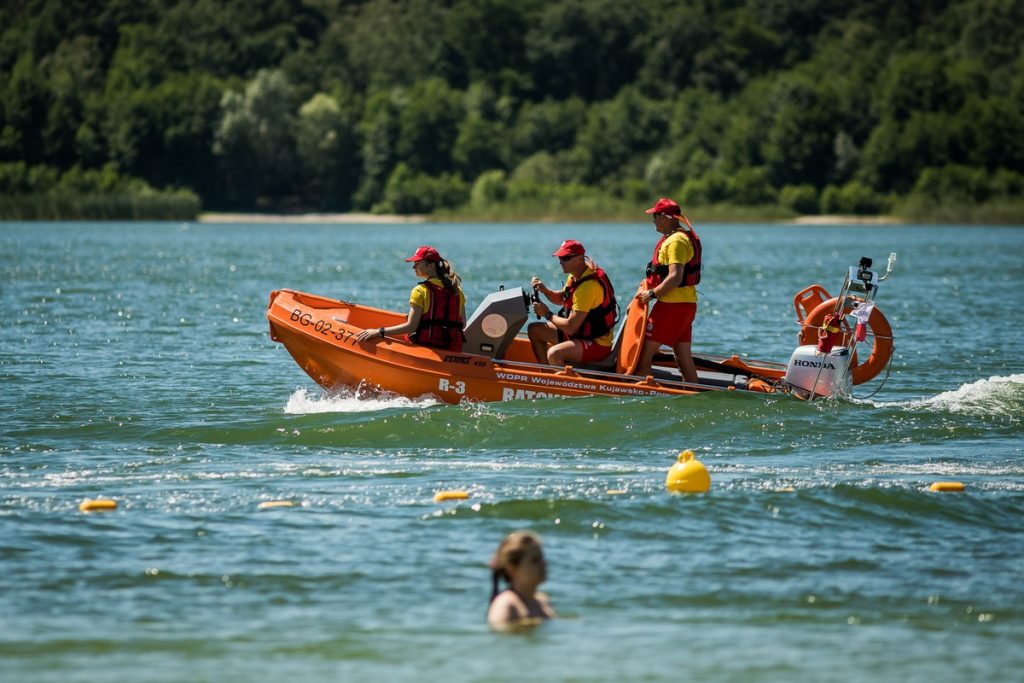
Safe patrols!
Today (29 June) we celebrate WOPR Lifeguard Day, an opportunity to thank the women and men who work every day to keep people safe at lakes, rivers and other inland waters across Poland.
“I wish all lifeguards calm and uneventful patrols. May there be as few life-threatening emergencies as possible, and may your skills be needed most often during training sessions and exercises,” says Marshal Piotr Całbecki.
To help keep people safe at the water’s edge—and in the mountains—the free Ratunek (“Rescue”) mobile app enables emergency services to quickly locate people in need. We encourage everyone to download the app to their mobile phones so they can contact water rescue services without delay in a life- or health-threatening situation.
The app automatically connects users to the appropriate emergency number integrated into the system, while rescuers receive the caller’s location with an accuracy of up to three metres. The emergency number for water incidents is 601 100 100. Calls from the Kujawsko-Pomorskie Region are handled by the Regional Water Rescue Coordination Centre in Kruszwica, which operates 24 hours a day, year-round.
Summer Water Patrols
As every year, the Kujawsko-Pomorskie Region self-government is financing summer WOPR patrols and lifeguard duty stations, allocating PLN 130,000 for this purpose.
Water rescue teams equipped with motorboats will patrol:
- the Włocławek Reservoir,
- the Żur Reservoir,
- Lake Gopło,
- the Small and Large Żnin Lakes,
- the lakes of the Brodnica Lake District,
- the Vistula River,
- the Brda River,
- the Wda River.
Lifeguards will also be on duty at WOPR rescue stations and public bathing areas in Bydgoszcz, Tleń, Borówno, Toruń, the Koronowo Reservoir, the Włocławek Reservoir, Lake Gopło, Żnin, Brodnica, Tuchola, Solec Kujawski and Ciechocinek.
Supporting Water Rescue Services
The Kujawsko-Pomorskie Region continues to support water rescue organisations through investment in modern equipment and training.
Funding from the 2014–2020 Regional Operational Programme made it possible to purchase training equipment and specialist rescue gear, including underwater scooters, drones with thermal imaging cameras, sonar systems, rescue sleds, dry suits, radios, rescue boats and defibrillators.
An EU-funded training project also enabled nearly 1,000 residents of the region to gain qualifications required to work as water rescue lifeguards and to provide first aid.
Being a water rescue lifeguard is a source of pride.
Marshal’s Office Press Office
29 June 2026