

Small Insects, Great Importance
On World Bee Day, we would like to highlight that the regional self-government of the Kujawsko-Pomorskie Region has for many years consistently supported both beekeepers and initiatives aimed at protecting pollinators.
This year, for the fourth time, the regional self-government has allocated funds for the winter protection of bee colonies. The total amount of support is 500,000 PLN. Grants will be awarded to regional beekeeping associations from Bydgoszcz, Toruń, and Włocławek, as well as organizations bringing together beekeepers. The funds will be used to purchase specialized high-protein feed, known as “bee cake,” which helps bee colonies survive the most difficult period of the year. The program covers nearly 70,000 bee colonies across the region. Agreements for the implementation of the initiative will be signed soon.
This year, the National Rural Network unit (KSOW+) managed by the regional self-government is carrying out educational initiatives supporting the development of beekeeping and promoting knowledge about bee protection. Their aim is to raise awareness of threats facing pollinating insects and to promote natural methods of running apiaries. In March, the 34th Beekeepers’ Forum was held in cooperation with the Regional Beekeepers’ Association in Toruń. Nearly 300 people took part in the event. During the first quarter of this year, training sessions for beekeepers were organized in Golub-Dobrzyń, Chełmża (Toruń County), Minikowo (Nakło County), Cieślin (Inowrocław County), and Włocławek. The sessions covered, among other topics, modern methods of apiary management, combating bee diseases, current legal regulations, and activities aimed at improving the productive value of bee colonies.
The regional self-government, in cooperation with our landscape parks, is also implementing a major biodiversity protection project focused on safeguarding pollinating insects. The first stage of the work involved an inventory of pollinators across all ten landscape parks in the region. The project (with nearly 7 million PLN in funding from the European Funds for Kujawy and Pomorze) also includes the creation of flower meadows, the purchase of insect hotels and watering stations for pollinators, as well as educational materials for workshops and activities aimed at preschool children, school students, seniors, and farmers.
See also: Pollination – Essential for Ecosystems
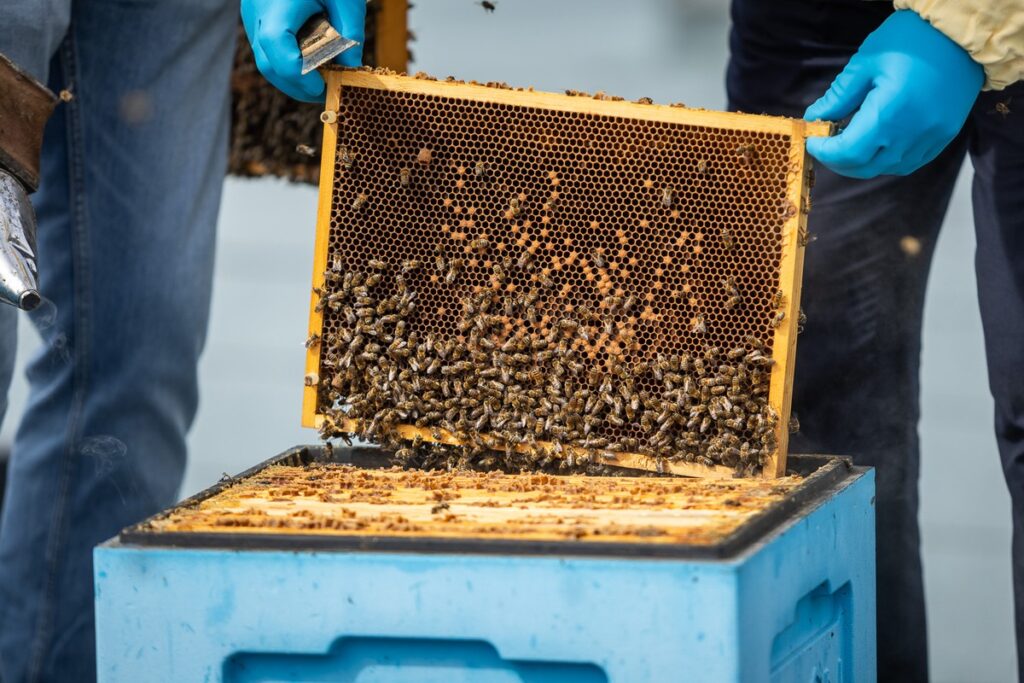
For the past ten years, an apiary with five bee colonies has been located on the roof of the Marshal’s Office in Toruń. Each colony consists of one queen bee and around 30,000 worker bees. This year, honey from blooming maple trees has already appeared in the hives, although the quantity is significantly lower than in previous seasons. The cold April weather slowed the development of bee colonies, and plants produced less nectar. Bees were also able to leave the hives less frequently, as they require suitable temperatures and favorable weather conditions for flying. Honey harvesting takes place once a year, usually at the end of June. Each hive contains approximately 25 kilograms of honey.
See also: Honey – Best Straight from the Apiary!
Department of Agriculture and Geodesy and the Press Office of the Marshal’s Office
May 20, 2026