


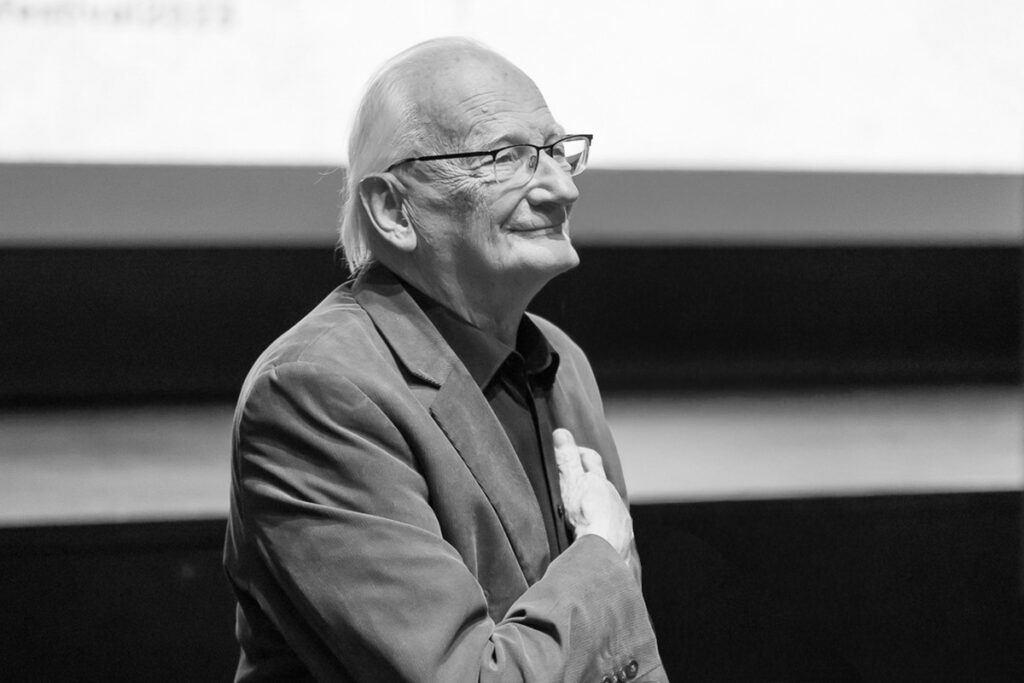
Stanisław Janicki, Laureate of the Marshal’s Film Award, Has Died
Stanisław Janicki has passed away – an outstanding journalist, film lover and historian, and the creator of the legendary television program In the Old Cinema (W starym kinie). It was the longest-running film series in Poland, broadcast from 1967 to 1999. For decades, he popularized pre-war Polish cinema and reminded audiences of the stars of the silver screen from years gone by. He was the author of more than a dozen books, including In Old Polish Cinema, Polish Film from A to Z, Japanese Cinema, and Andrzej Wajda’s Film Dreams. He was 92 years old.
Stanisław Janicki was closely connected with the Kujawsko-Pomorskie Region. In 2023, during the Old Film Festival in Bydgoszcz, he received the Marshal of the Kujawsko-Pomorskie Region’s Pola Negri Film Award for lifetime achievement. In his public statements, he often emphasized his great admiration for Helena Grossówna, who came from Toruń, calling her one of his favorite actresses of pre-war cinema. He appreciated her talent and reminded audiences of the importance of her achievements for the history of Polish cinematography.
Below we recall an interview with Stanisław Janicki conducted by Mariusz Załuski and Ryszard Warta for the portal Kujawy-Pomorze.info.
Mariusz Załuski, Ryszard Warta: Why interwar cinema in particular? In the 1960s, when In the Old Cinema was created, that probably was not the most fashionable style among young film critics. Italian and French cinema were experiencing so many exciting developments at the time.
Stanisław Janicki: The program In the Old Cinema was pure coincidence. At that time, it really didn’t interest me. After the political thaw of 1956, Polish cinemas opened up to American and French films, and those were much more important to us. On the other hand, I was born in 1933, on November 11th. I always emphasize that when I was born, Marshal Piłsudski was reviewing a military parade, and the national anthem was being played throughout Poland. The pre-war years, especially the 1930s, are still alive in my mind. I grew up in that atmosphere – first through family stories, and later through films. And for me, the wartime period was simply a continuation of pre-war Poland.
Let us pause for a moment at those times. You were born in Czechowice-Dziedzice, near Bielsko-Biała, where you still live today.
I was literally born in an oil refinery because my father worked there in a senior position. Unfortunately, my mother suffered from tuberculosis, which at the time was effectively a death sentence. Even though my father earned very well and she spent all her time in sanatoriums, I do not remember her at all. She died two months before the outbreak of the war. We were left alone, and my father was drafted into the army, so in practice we were without parents. Our aunt took care of us. Together with her we traveled all the way from Warsaw to the vicinity of Lviv. Later it turned out that the German-Soviet pact contained a small clause allowing those born within the Reich to return to their place of residence. So we returned, although it was not an easy decision because my aunt’s husband had fought in all three Silesian Uprisings. During the occupation he hid in a basement the entire time.
Did your father also return after the September campaign?
He did. He was released from a POW camp and started working in a cloth factory office owned by a relative of ours. My father, however, had a very pre-war habit – just like my grandfather in Austrian times. On Sundays he went to church, not to just any Mass, but to the solemn High Mass, as every respectable Catholic and citizen should. Afterwards they returned home for a formal family dinner, but first there was always a stop at a restaurant in the market square for “men’s conversations” over vodka. My father had strong opinions and was talkative, much like I am. One summer day, they were talking near an open window when a local man overheard them and immediately reported him to the Germans. Soon afterward, a scene unfolded that I still remember vividly. We were eating breakfast when the door suddenly opened and two Gestapo officers entered in elegant black uniforms. A third stayed outside and a fourth waited in a black convertible. “Janicki?” they asked. “Janicki.” “Get ready.” Beforehand, they had thrown us children out of the room.
You describe it almost like a film.
Because I still see those scenes before my eyes. No wonder those years shaped me. And returning to In the Old Cinema – in the 1960s we loved movies and watched them in cinemas, while television was not especially attractive to us. I had actually seen television from the very beginning – it operated from an ordinary apartment on Solec Street, two rooms separated by glass where they “made television.” So when we had Hollywood, French cinema, and Italian neorealism in theaters, that little box did not interest us. I had a university friend, Hania Goszczyńska, who was the only one among us to start working in television. She thought ahead and believed the medium would develop. One day she called me, desperate for help. She had prepared a program about Polish directors – film clips combined with directors and actors invited into the studio. Remember, this was the era of live television. The presenter became ill halfway through the series.
And someone had to replace him?
Exactly. She suddenly needed someone to host four episodes. She remembered her good friend and called me. Well, when a woman asks for help, you agree. The studio was tiny. There was a little platform, an armchair, and a huge camera hanging practically in front of my face. But the worst part was the lighting. There were no television lights then, only giant film studio spotlights borrowed from Łódź, designed to illuminate forty meters, not forty centimeters. That finished me off. I decided television was not for me. I completed those episodes and asked Hania never to suggest anything like that again. Two weeks later she called back: the management had watched our program and wanted a new one – a show about 2 feature films from around the world. An entire hour! Broadcast on Sunday at noon, the best possible time slot back then. What convinced me was the promise that nobody would interfere with what we were doing.
And that is how you entered the world of pre-war Polish cinema…
Yes, and that was when the difficulties began. I was interested in Polish cinema, but contemporary cinema – Kawalerowicz, Wajda, Munk. Pre-war cinema was another matter entirely. Professor Toeplitz, who taught our film specialization at Warsaw University, showed us pre-war Polish films selected intelligently: one simple comedy, one decent melodrama, and one genuinely ambitious film. That was my image of pre-war cinema. But I was working for Polish television, and viewers expected Polish films. So I had to immerse myself in that cinema and learn those films by heart.
In 1967, when In the Old Cinema began, you were only 34 years old and speaking about a world that many viewers still remembered personally…
Of course. I understood perfectly that while I was seeing these films for the first time, many viewers had watched them in cinemas before the war. I was at a disadvantage. Yet somehow I won over audiences for 32 years. I spent endless hours in editing rooms, importing films and learning them. “This is Eugeniusz Bodo, that is Aleksander Żabczyński. This is Elżbieta Barszczewska, that is Jadwiga Smosarska.” I had heard of them before, but honestly I could not tell them apart because I had never watched those films. So I studied them intensively.
The program evolved in many directions over time.
Because eventually I began to feel a little bored. So I searched for new themes. I organized several festivals of old films devoted to particular actors, such as Eugeniusz Bodo. Later I made a full documentary film about Bodo’s life and death.
In our region, there has recently been a revival of interest in pre-war Polish cinema. This is connected, among other things, with preserving the memory of the stars of that era — Pola Negri came from Lipno, while Helena Grossówna came from Toruń, where her family home was successfully saved not long ago…
By the way, Helena Grossówna is one of my favorite actresses.
She acted only for a few years, yet appeared in around twenty productions.
She was an excellent actress and directors loved working with her.
The symbol of worldwide success is Pola Negri, who became a Hollywood star. Why has her success never been repeated? We have internationally acclaimed directors and outstanding cinematographers, but since Negri’s time, no Polish actress or actor has achieved a comparable position.
To make a true career, an actor must arrive at the right moment – when there is suddenly a demand for exactly that type of actor because audiences are tired of previous stars. And honestly, it has little to do with talent.
Pre-war Polish cinema, unlike the film industry in the United States, was still — as someone aptly described it — a “craft-based economy.” Films were produced by 150 studios, one third of which made only a single film…
That was the method: a production company was often created simply to make a single film. Real film industry structures in Poland only began appearing around 1938. That was when large studios modeled after the American system emerged, complete with their own facilities and actors.
The development of pre-war Polish cinematography was abruptly and tragically interrupted by the outbreak of the war. In what direction might Polish cinema have evolved if it had been allowed to develop normally?
It would probably have developed in a similar direction to cinema in Czech Republic and Hungary. We produced only 20 to 30 films a year, so we could not compare ourselves with countries like Germany. It was Germany that could compare itself to Hollywood.
Do you have any particular favorites among the filmmakers and stars of that era, such as Helena Grossówna, whom you mentioned earlier?
Józef Lejtes, unquestionably a European-level talent. Aleksander Ford, a rebel – half the things he attempted failed, but the other half succeeded brilliantly. His post-war films such as Border Street and Five Boys from Barska Street were masterpieces. Ford also had an extraordinarily interesting life. He was a great womanizer. Nobody really understood why women found him so irresistible. He was short, but he broke many hearts.
You became his biographer – you published a book about the director and made a documentary film about him.
Aleksander Ford had an extraordinarily interesting life. For example, he was a notorious womanizer. Why was he so successful with women? Nobody really knows. He was short, but he knew how to break hearts. I was writing a book about him at a time when people would gladly have drowned Ford in a spoonful of water. A publishing house proposed that, as part of a series on film directors, I should write a book about Aleksander Ford. Nobody else wanted to take it on, but I agreed. I knew what awaited me because I had already known him before. I contacted him, and to my surprise, he agreed. I did not take notes – in those days interviews were recorded on a tape recorder weighing about 20 kilograms. Fortunately, I transported it in my Syrena car. Ford lived on Narbutta Street. I arrived for the first recording session: a beautiful pre-war apartment building, a lovely flat. I was fully prepared, with all my questions written down. I asked whether we could begin. He nodded, so I asked the first question – silence. By the third minute I was already becoming seriously worried. I asked another question – silence again. A third question, and exactly the same thing happened. Finally, I said: “Mr. Aleksander, this does not seem to be working today, so perhaps we should arrange another meeting.” About two weeks later Ford called me. He said he would pick me up. He arrived in a huge, beautiful Mercedes. There were even jokes about it at the time: “Oh, Ford must have been driving that big Mercedes, because you could not see anyone behind the wheel!” But he really was an excellent driver. Once we arrived, everything changed as if by magic. We recorded four interviews, I think. And when the book was finally finished, Ford did not change a single comma in it.
In the Old Cinema was a phenomenal program, watched for 32 years. It spanned several eras of Polish television. You began during the time of Włodzimierz Sokorski, then came the 1970s and the famous television era of Maciej Szczepański, and you finished during the presidency of Robert Kwiatkowski… Which of these eras in the history of Telewizja Polska do you remember most fondly?
I do not remember any of those eras sentimentally. Television was simply my profession, although I did not do it only for money. The pay was miserable anyway. I was never truly part of the television establishment.
Was that because you were never actually employed by television?
To be honest, I was for a short time – about a year and a half – in the film editorial department. But in general, I had nothing to do with how television functioned as an institution. My only real contact was with Hania Goszczyńska, who unfortunately has since passed away, and practically none with the “top brass.” Well, there was one occasion – it happened to coincide with one of my anniversaries, and since I have lived a long life, I have had quite a few anniversaries. At that time Janusz Wilhelmi invited me to his office. We talked for half an hour, shook hands, and that was it. That was the extent of my contact with the management. Still, all kinds of anecdotes circulated, and people told them to me. For example, about the aforementioned Maciej Szczepański – he could not stand men with long hair.
One could say that during the Edward Gierek era, the “crew cut” was in fashion…
…So there are two men walking toward each other in the long corridor of Block F. On one side is President Maciej Szczepański, and on the other a young man in his twenties, a new television employee with long hair. They stop. Szczepański takes out 10 złoty, hands it to the young man, and says: “Now you will go and get a haircut.” After a moment, the young man reaches for his wallet, takes out 20 złoty, gives it to Szczepański, and says: “And now you can f*** off.” He had no idea who he was talking to. He was a completely new employee.
Did you ever have problems with censorship?
Surprisingly, no. There was indeed a special censor assigned to In the Old Cinema, but I never had serious problems.
Let us move away for a moment from In the Old Cinema – altogether, as a filmmaker, you completed as many as 40 productions. And one of them was even made in Toruń.
In Toruń I made the film Kruk (The Raven), a story about a boy whose father is a trumpeter. We staged incredible battle scenes there – at that time! The Toruń military garrison lent us one or two army companies for several days, though I no longer remember exactly how many. Later it became rather amusing, because as production continued and spring arrived, various military exams were taking place, so we kept losing soldiers. Every day the production manager would come to me and say: “Today we have ten fewer.” By the time we were shooting the final scenes, I had to improvise carefully so the audience would not notice how few of them were left.
Let us go even further back in time. Before television, there was the press – the most traditional, printed form of journalism. That was where you gained your journalistic experience.
Television only came in 1967. I studied between 1950 and 1954, and I had already started working in 1952. Was it because I was so diligent? No. From the very beginning I knew that film was what interested me most. At that time, however, the rule was simple: you could get residence registration in Warsaw only if you had a job, but you could get a job only if you had residence registration. So one had to come up with a solution. I could have gone into the security services, but that was completely out of the question. Then I came up with the idea that perhaps the military might help…
Though you did not exactly build a military career…
During our studies we used to go to Bielany, where there was practically nothing at the time, for various military exercises. One day during roll call I heard the command: “Stanisław Janicki, step forward.” About seven or eight of us stepped forward, and we were informed that by order of Marshal Konstanty Rokossowski, we were being classified as Category “D” and released from service…
…but you did end up in the military press.
I found out where the editorial offices of the military newspapers were located: 77 Grzybowska Street. I did not know anyone there. Among the publications based there were the weekly Żołnierz Polski (Polish Soldier) and the daily Żołnierz Wolności (Soldier of Freedom). So that was where I knocked on the door. I already knew that such matters were not handled through the editor-in-chief, but through the editorial secretary. He was a lieutenant in uniform. I laid my cards on the table and explained my situation – that I was living in a student dormitory and wanted to see what the work of a real newspaper looked like. And back then it was completely different from today. Newspapers were typeset at night, there were compositors working there – it was fascinating, and I genuinely wanted to see all of it. So they hired me. And the compositors played a wonderful prank on me, because I became what they called the “fresh head.” That was the person who, after the issue had been typeset and a proof copy printed, read everything from beginning to end one final time. If he spotted any remaining errors, he could still correct them. It was the very last moment for revisions before the printing presses started running. A car would pick me up at three in the morning and take me to the editorial office. The compositors were an exotic professional group – they had their own customs, their own language, their own jokes. They were like a clan. One day I was reading through the paper and finally reached the obituary section on the last page. I looked down and saw: “The late Stanisław Janicki.” I wondered whether it could simply be someone with the same name. So I continued reading: “With great sadness we announce that our unforgettable colleague, a highly promising young man, has passed away…” and so on. Everything exactly as it should be, printed right beside the real obituaries…
A rather peculiar sense of humor indeed…
I simply wanted to learn journalism there. For example, they once sent me to do a report at the Sea Fisheries Institute in Gdynia. I traveled all night by train, arrived there, and had breakfast in a milk bar. Fortunately, it was a modest one – some sort of cocoa that was hardly cocoa at all, a croissant, and scrambled eggs made from two eggs. Those were times when journalists, even little nobodies like me, were welcomed with open arms. At the Institute they told me they had just replaced the engine in a small research vessel – really more of a fishing boat equipped for marine studies – and asked whether I would like to join them on a post-repair trial voyage. Of course I wanted to; I had never even stood on the deck of a ship before. And that was when it began. They did not even sail very far, but they immediately started testing everything: full speed ahead, stop, hard to starboard, hard to port – every maneuver imaginable. At that moment I could only thank God that I had eaten such a small breakfast. That was also when I had a certain cinematic adventure.
In Gdynia?
Actually, in Gdańsk. Before the war, when my father was transferred to the Warsaw headquarters of Standard Oil, he traveled abroad quite often. One of his regular destinations was the Free City of Danzig. He told me many stories about it – at that time I knew more about the Free City of Danzig than about any other city. So I eventually decided to see it for myself. Of course, I knew there had been fighting and that the city was destroyed. I remember walking along the Long Market: the facades of the buildings were still standing, but behind them there were only ruins. There was a cinema called Leningrad with two screening rooms. A woman told me that the film downstairs had already started and was halfway through, but another screening in the small hall was about to begin. I bought a ticket and entered the theater. There was not even half a seat free – the place was packed. I stood leaning against the back wall. The film was strange; they were speaking some unfamiliar language. What was it? There was no one to ask – today I would have asked myself. When I was leaving, I looked at the poster: The Crucified Lovers. There was also information that it was a Japanese film. It made an enormous impression on me.
And was that the beginning of your fascination with Japan?
Yes, that was when my interest in Japan began. I returned to Warsaw and started searching for information, but in those days where could one find anything at all about Japanese cinema? Eventually I found a small brochure titled Asian Film, written in Czech – but that was no problem for me. There I found information about the film The Crucified Lovers, directed by Kenji Mizoguchi. That was when I realized it was as if someone had come to Poland and the very first film they saw was Ashes and Diamonds by Andrzej Wajda. That was roughly the same level of artistic importance and prestige.
Your interests were remarkably diverse: Japanese cinema, film history, documentary filmmaking, journalism, books… Yet people associate you primarily with In the Old Cinema.
I possess one ability God gave me: I never attach too much importance to such things. I tried to do what interested me. Some things succeeded, others did not. Apart from the popularity television brought me, there were no special rewards.
Thank you for the interview.