

Historic arcaded house from the Żuławy region at the Olenderski Park Etnograficzny
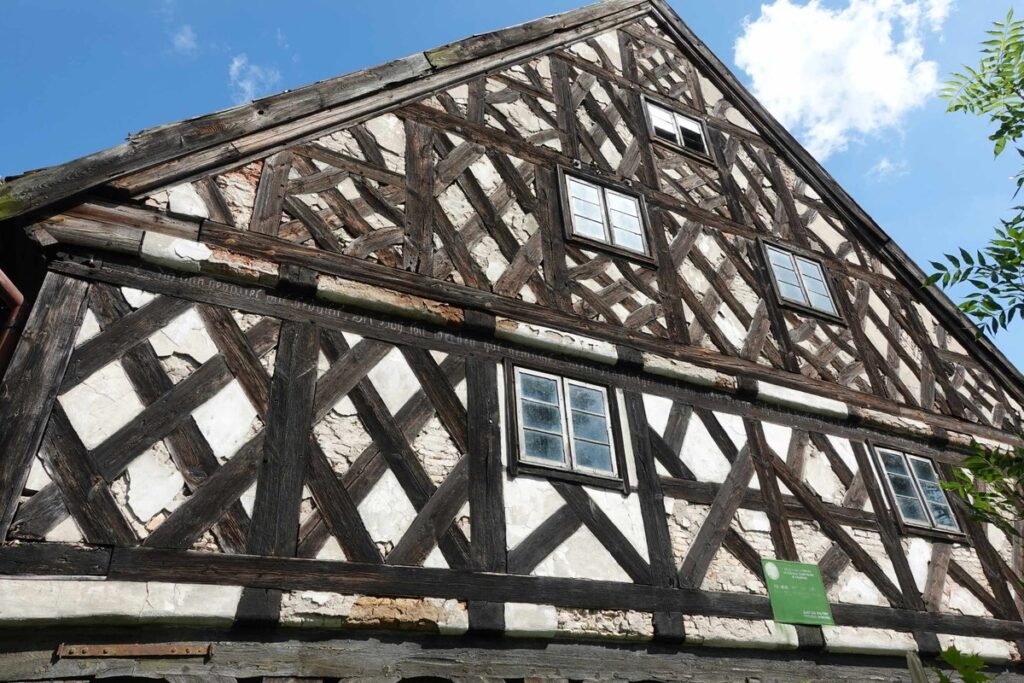
An eighteenth-century house featuring an elaborate arrangement of wooden beams in its half-timbered walls will become part of the newly created Żuławy section at the Olender’s Ethnographic Park in Wielka Nieszawka near Toruń County.
“The Ethnographic Museum, whose branch includes the open-air museum near Toruń, received PLN 340,000 in funding from the National Institute of Museums for the purchase of this picturesque building. I am pleased that the structure will enrich the exhibition of our ethnographic park in Wielka Nieszawka, which preserves the heritage of Olender settlement,” said Piotr Całbecki.
The building was erected in 1751 for Michael Gehrt by the builder Georg Pöck. The construction date and the names of both the first owner and the builder are preserved in an inscription on the structural elements of the building’s gable.
The house is located in the Żuławy region in the village of Stalewo, near the border between the Pomorskie and Warmińsko-Mazurskie voivodeships. The ground floor was built of brick masonry, while the decorative highlight of the building is the timber-frame construction of the upper storey. The architectural value of the structure lies in its form and the ornamental arrangement of beams in the half-timbered walls. The construction solutions used by the builder demonstrate exceptional craftsmanship.
Following the purchase, whose total cost will amount to PLN 415,000, the necessary conservation documentation and dismantling plans will be prepared. The building will then be transported and reconstructed as the first structure in the newly established Żuławy section.
In connection with the planned expansion of the open-air museum, Piotr Całbecki, Hubert Czachowski and Katarzyna Streich signed a letter of intent under which the ethnographic park will be expanded with new land directly adjacent to the existing museum grounds.
The Olender’s Ethnographic Park invites visitors into the world of former Vistula settlers — Protestants from the territory of present-day Netherlands who began settling floodplain areas along the Vistula River from the sixteenth century onward. On an area of five hectares, an Olender village consisting of three homesteads has been recreated. The site features residential and farm buildings from the eighteenth and nineteenth centuries relocated from the Lower Vistula Valley. Their interiors faithfully recreate the atmosphere of Olender homes. The charm of the site is enhanced by gardens and orchards. An important part of the exhibition is also the preserved original Mennonite cemetery in situ, which remained in use until 1945.
The regional government oversees seventeen cultural institutions offering a wide range of cultural activities and events:
- Filharmonia Pomorska im. Ignacego Jana Paderewskiego w Bydgoszczy
- Galeria i Ośrodek Plastycznej Twórczości Dziecka w Toruniu
- Galeria Sztuki Wozownia
- Muzeum Archeologiczne w Biskupinie
- Muzeum Etnograficzne im. prof. Marii Znamierowskiej-Prüfferowej w Toruniu
- Muzeum Ziemi Kujawskiej i Dobrzyńskiej we Włocławku
- Opera Nova
- Ośrodek Chopinowski w Szafarni
- Pałac Lubostroń
- Teatr im. Wilama Horzycy w Toruniu
- Wojewódzka Biblioteka Publiczna i Książnica Kopernikańska w Toruniu
- Wojewódzka i Miejska Biblioteka Publiczna im. dr Witolda Bełzy w Bydgoszczy
- Wojewódzki Ośrodek Animacji Kultury w Toruniu
- Kujawsko-Pomorskie Centrum Kultury w Bydgoszczy
- Kujawsko-Pomorski Teatr Muzyczny w Toruniu
- Kujawsko-Pomorskie Centrum Dziedzictwa w Toruniu
- Kujawsko-Pomorskie Centrum Edukacji i Innowacji w Toruniu
Press Office of the Marshal’s Office
27 May 2026