


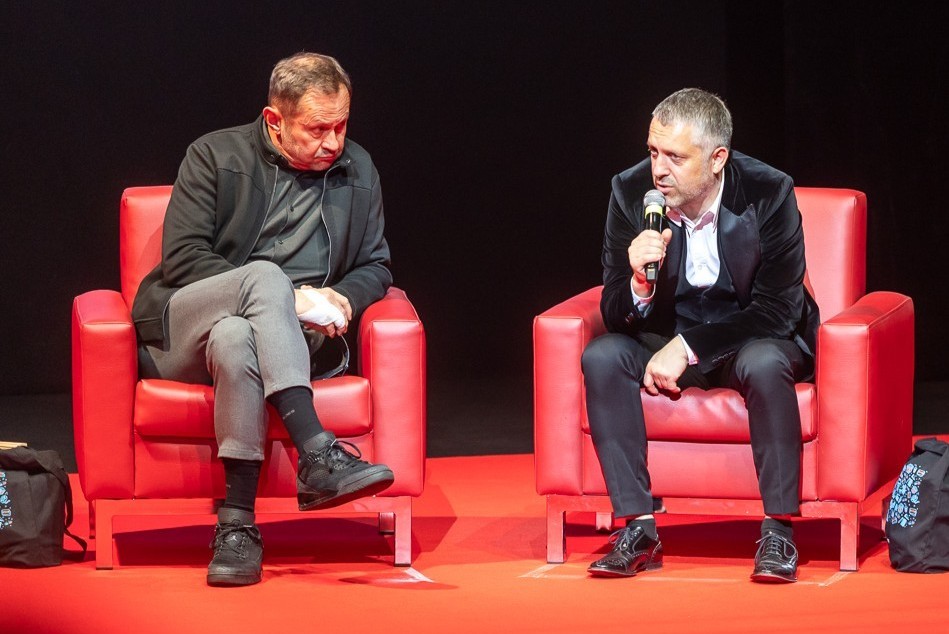
Wojciech Gostomczyk
“‘The Good Home’ breaks the taboo of domestic violence like the Berlin Wall in 1989: decisively, boldly, and in a way that cannot be undone. It is a film that opens a conversation where silence had prevailed for years,” says Wojciech Gostomczyk, producer of Wojciech Smarzowski’s latest work and head of the production studio “Lucky Bob.” A partner of “The Good Home” is the regional self-government of the Kujawsko-Pomorskie Region.
You graduated in directing from the Warsaw Film School. What inspired you to become involved in film production rather than focusing solely on directing?
Wojciech Gostomczyk: The impulse to do more than just direct films came from my friendship with Wojtek Smarzowski. He was the one who proposed that we produce films together, where I could learn a great deal about directing. It turned out that this kind of practical experience was far more valuable than any classes at film school. We have already completed another film together, and I am certain that “The Good Home” is not the end of our collaboration. Wojtek is a true mine of knowledge and a brilliant teacher, and working with him gives me enormous joy and motivation.
I know that one day I will make my own great film, but for now Wojtek’s proposals are simply impossible to refuse.
What exactly does a film producer do?
A producer is the person who organizes and oversees the entire filmmaking process – from the initial idea to the premiere. The producer makes sure the film gets made, is completed on time, and stays within budget. Of course, the producer also takes financial and creative responsibility for the whole project. One of my main tasks is securing financing for the production. I also hire the entire crew needed for the film, including the director, screenwriters, actors, and technicians. I coordinate the budget and shooting schedule as well. Another important responsibility is creative supervision – making sure the film is made according to the original vision. Finally, there is promotion and distribution of the completed film. And then we wait to see whether the production succeeds commercially.
Your production company “Lucky Bob” is now a recognizable brand in the film industry. Its artistic supervisor is Wojciech Smarzowski, one of the most sought-after Polish directors today. Why did you decide to establish the studio in Bydgoszcz, far from the obvious film centers?
I make films in Bydgoszcz because I feel deeply connected to this place. I believe in the potential of our region and want to actively contribute to its development. Instead of following the established paths of the biggest film centers, I prefer to build value and culture here, where my roots and heart are. Every production created in our Kujawsko-Pomorskie Region is not only an artistic project for me but also an investment in the local community and its future.
Which of your productions so far do you consider the most important from a professional point of view?
The most important projects in my career so far have been three productions: “The Wedding” by Wojtek Smarzowski from 2021, “The Palace” by Roman Polański from 2023, and the latest one – “The Good Home.” Each of these films became a milestone for me for completely different reasons. I work with Wojtek because together we create cinema that moves people, provokes discussion, and truly changes something. Looking back, these films represent the greatest fulfillment of my dreams: they give me the feeling that I have made an authentic contribution to Polish cinema and that my voice is part of conversations about difficult and often unspoken issues.
Working with Roman Polański, on the other hand, was the fulfillment of a childhood dream. As a boy, I absorbed everything that came out of legendary Hollywood, and somewhere deep down I believed that one day I would become part of that world myself. Participating in the production of “The Palace” was the moment when that dream became reality—a moment that showed me that if you consistently follow your path, even the most distant dreams can eventually come true.
“The Good Home” became the biggest Polish box-office hit of 2025, attracting more than two million viewers to cinemas. Did you expect such success?
Honestly? Absolutely not. “The Good Home” is not a film that offers easy answers, and we were genuinely afraid that audiences would want to distance themselves from such a demanding subject. But something beautiful happened: people not only went to see the film, they wanted to talk about it, share their own stories, and express their emotions. You could say that “The Good Home” gave women strength and courage to begin speaking about the harm they had experienced. It showed that our society is maturing enough to confront difficult, painful, and uncomfortable realities, and that cinema can and should address important issues. I never expected such extraordinary attendance figures. But for me, the greatest reward was seeing huge crowds come to watch such a difficult film.
“The Good Home” is a shocking story about domestic violence. “This film hurts like a bruise, it is like being hit in the head with a hammer, without any assurance that it will not happen again moments later, even harder,” wrote the well-known critic Tomasz Raczek. How did the idea for the film emerge?
The idea for “The Good Home” came from the need to tell a story addressing real social problems. After “The Wedding,” Wojtek and I felt that we wanted to make another film that would speak out on an important issue, this time something more intimate and close to the everyday reality of many families. The statistics regarding domestic violence after the pandemic were truly frightening, and we felt we could not remain indifferent. “The Good Home” was therefore created out of a need to respond to reality and portray it as it truly is.
The issue of domestic violence – not only physical but also psychological and often sexual – is highly relevant, yet for years it remained taboo. Can “The Good Home” help change that permanently? The first effects are already visible: support organizations such as Blue Line and Feminoteka report that after watching the film, significantly more people, mainly women, have been reporting violence and seeking help.
Does “The Good Home” break the taboo? Based on what I read online and hear during meetings with audiences, I have no doubt that it does. The film touches on issues of violence that until now were spoken about only in whispers, if at all. Our film entered a space filled with fear, shame, and silence – and shattered that silence with symbolic force. More than two months after the premiere, I dare say that “The Good Home” breaks the taboo of domestic violence like the Berlin Wall in 1989: decisively, boldly, and in a way that cannot be reversed. From social media and meetings with viewers across Poland, I know this is a film that opens conversations where silence had prevailed for years. That is probably why the number of people calling support organizations and seeking help after screenings has increased; in fact, a contact number for victims of violence is displayed on the cinema screen after the film.
Working with Smarzowski is a great honor, but also a major challenge. What is the most difficult aspect of that collaboration?
The most difficult thing about working with Wojtek is that there is absolutely no room for mistakes or shortcomings. He is a very serious artist dealing with equally serious subjects, which means every part of the production must be perfected down to the smallest detail. From legal matters and finances to the entire organization – everything has to function flawlessly.
Smarzowski is known for his uncompromising artistic approach, while you have to keep an eye on the budget. Those two things do not always go hand in hand, which probably does not make collaboration easier?
Such cooperation requires complete responsibility and concentration, but it also gives you the feeling that you are creating cinema of the highest quality.
Do you already know what your next joint production with Smarzowski will be about?
For many years I have dreamed of making a grand historical spectacle with Wojtek about the Slavs, the beginnings of the Polish state, Mieszko I, and his decision to adopt Christianity. It will certainly be one of the biggest and most expensive Polish productions ever made, mainly because of the costs related to set design. Historical epics sell well, so I believe such a project – especially one associated with Smarzowski’s name – would be a success.
Has working on high-profile titles such as “The Good Home” and “The Palace” changed the way you think about risk, scale of production, and the responsibility of a producer?
Working on such large productions definitely changed my understanding of risk. I realized that taking risks in film production is not only about courage or intuition – it is also about full responsibility for people, budgets, and logistics. Every decision must be carefully considered and perfectly prepared, while at the same time you need the courage to pursue unconventional solutions. This experience taught me how to balance boldness with security, which is essential when creating ambitious cinema.
How do you decide whether to commit to a project? What has to align before you say, “Okay, let’s do it”?
I decide to make a film when everything fits together: I like the script, I believe in the creators, and I feel it is truly worth taking the camera out of the trunk. That is a motto I learned from Wojtek: you have to make films for a reason, not just for money. If that “reason” is there, then I know the project makes sense and deserves full commitment.
After years in the industry, are you still able to sit in a cinema like an ordinary viewer without calculating attendance figures or budgets?
You can never completely switch that off, but there are still screenings where a good film simply draws me in like any other viewer. And then I know why I do all of this. Because if, every once in a while, I can still allow myself to be carried away by a story on screen, then cinema truly has meaning.
Which three films would you take to a desert island?
When it comes to Polish cinema, my favorites are certainly Wojtek’s films: “The Dark House,” “Traffic Department,” and “Rose,” and I would take them with me to a desert island. As for foreign titles, I could name many. In general, I love historical cinema, especially masterpieces such as “Braveheart” by Mel Gibson, “Schindler’s List” by Steven Spielberg, and “The Pianist” by Polański. These are true masterpieces that never grow old.
Thank you for the interview.
A partner of “The Good Home” is the regional self-government of the Kujawsko-Pomorskie Region – the latest work by Wojciech Smarzowski received funding from the Kujawy Pomorze Film Fund. Entities and individuals from our region were involved in its production. The production company was “Lucky Bob,” with Wojciech Gostomczyk and Janusz Hetman serving as producers, Joanna Drzewiecka, Andrzej Drzewiecki, and Adam Gudell as executive producers and co-producers, and Waldemar Kotecki as co-producer.
Department of Promotion
December 22, 2025