

“May You Have as Many Oxen as There Are Fence Posts”
An interview with Hanna Łopatyńska, Head of the Department of Folklore and Social Culture at the Ethnographic Museum in Toruń, and author of the exhibition and catalogue for the temporary exhibition Nativity Scenes for Christmas. The Collection of the Ethnographic Museum in Toruń.
Where do the nativity scenes presented at the Ethnographic Museum come from?
The exhibition features nearly 100 nativity scenes from most regions of Poland. They have been divided into three groups: carollers’ nativity scenes, sculptural nativity scenes, and Kraków nativity scenes. All of them come from the collection of the Ethnographic Museum. In recent years, our nativity scene collection has grown significantly, as the museum acquired many interesting objects from private collectors—Bolesław and Lina Nawrocki, as well as Piotr and Izabella Sałustowicz. As a result, some of the works are being shown to the public for the first time.
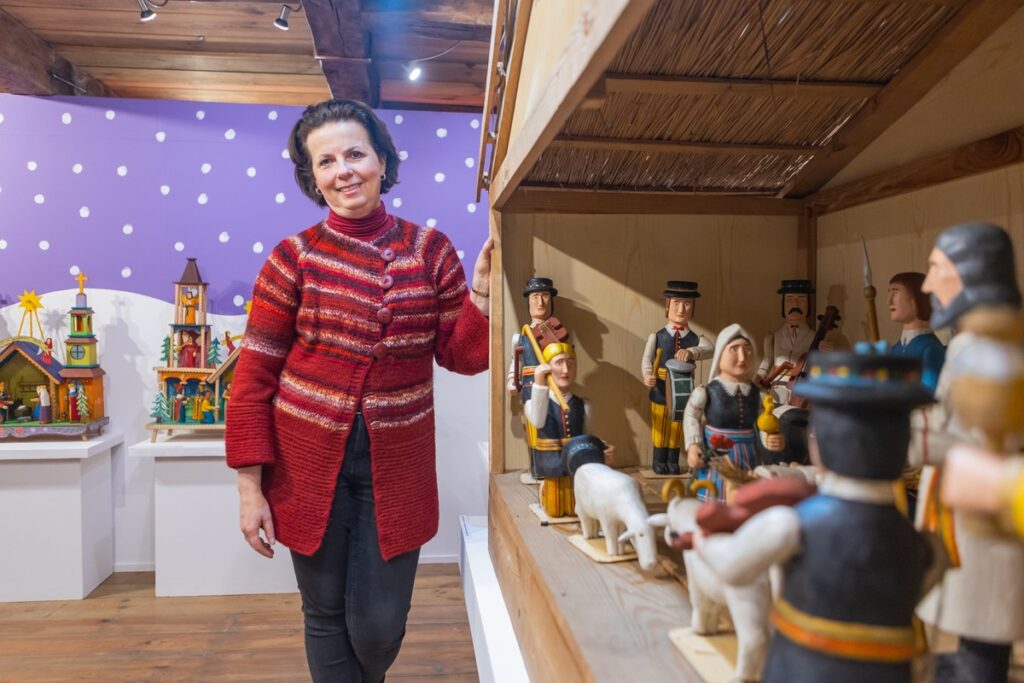
Hanna Łopatyńska, photo: Mikołaj Kuras for the Marshal’s Office of the Kujawsko-Pomorskie Region
What elements characterize traditional Polish nativity scenes?
Carolling with a nativity scene was popular throughout Poland, both in towns and in rural areas. Our knowledge of how nativity scenes looked at the beginning of the 19th century comes from the oldest surviving depictions—drawings by Kajetan Wawrzyniec Kielisiński. These were single-storey structures with two side towers slightly higher than the roofed central part, which housed stationary figurines of the Holy Family, shepherds, and animals. At the front of the nativity scene, in a narrow opening, the caroller moved puppets.
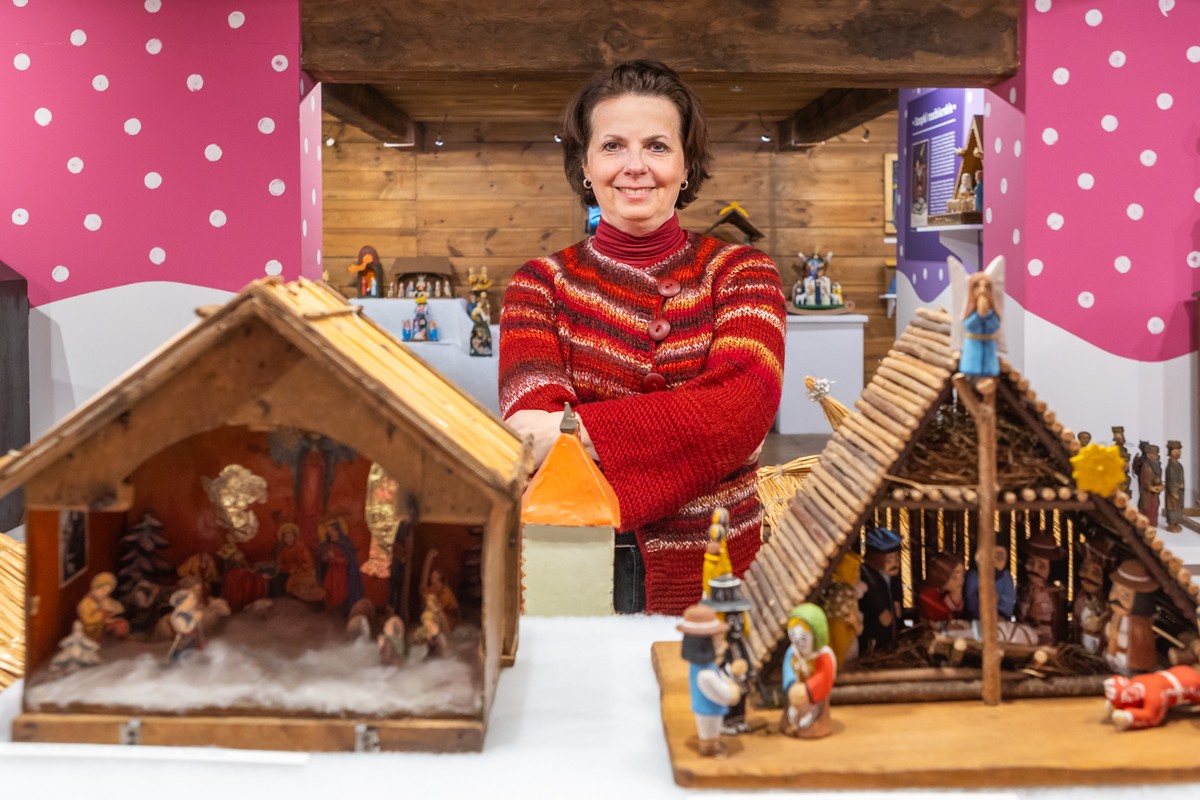
In some regions, nativity scenes were small and contained immobile figures. They had a gabled roof, most often covered with straw, and resembled simple, modest stables rather than church buildings. The interiors were frequently decorated with coloured paper, printed angels, or holy images. They were illuminated by a candle, an oil lamp, and later by a flashlight.
Larger nativity scenes had handles on the sides to facilitate transport; another method involved carrying them on one’s back using straps attached to the rear wall. Smaller ones were hung around the neck. Sometimes nativity scene makers drew inspiration from local architecture—for example, that of the Podhale region. Kraków nativity scenes, inspired by the city’s historic architecture, are known worldwide.
Did nativity scenes in the Kujawsko-Pomorskie Region differ depending on where they were made?
In the areas that today form part of our region, various types of nativity scenes were used. In the 19th century and before World War I, boys in Kujawy went carolling with carefully crafted nativity scenes featuring rich decoration and numerous figures—often carved—that moved when a string attached beneath the box was pulled. The interior was lit by a candle.
In Kujawy, as in other parts of Poland, nativity scene makers were often bricklayers who were unemployed during the winter months. Men went carolling with larger puppet nativity scenes. As we know from an interview with nativity scene maker Józef Zimecki from Włocławek (1888–1962), his father travelled throughout Kujawy with a nativity scene “as large as a wardrobe,” presenting a performance of his own design.
In Kociewie, Chełmno Land, and Pałuki, nativity scenes were modest and small in size, featuring stationary figures made of paper or wood.
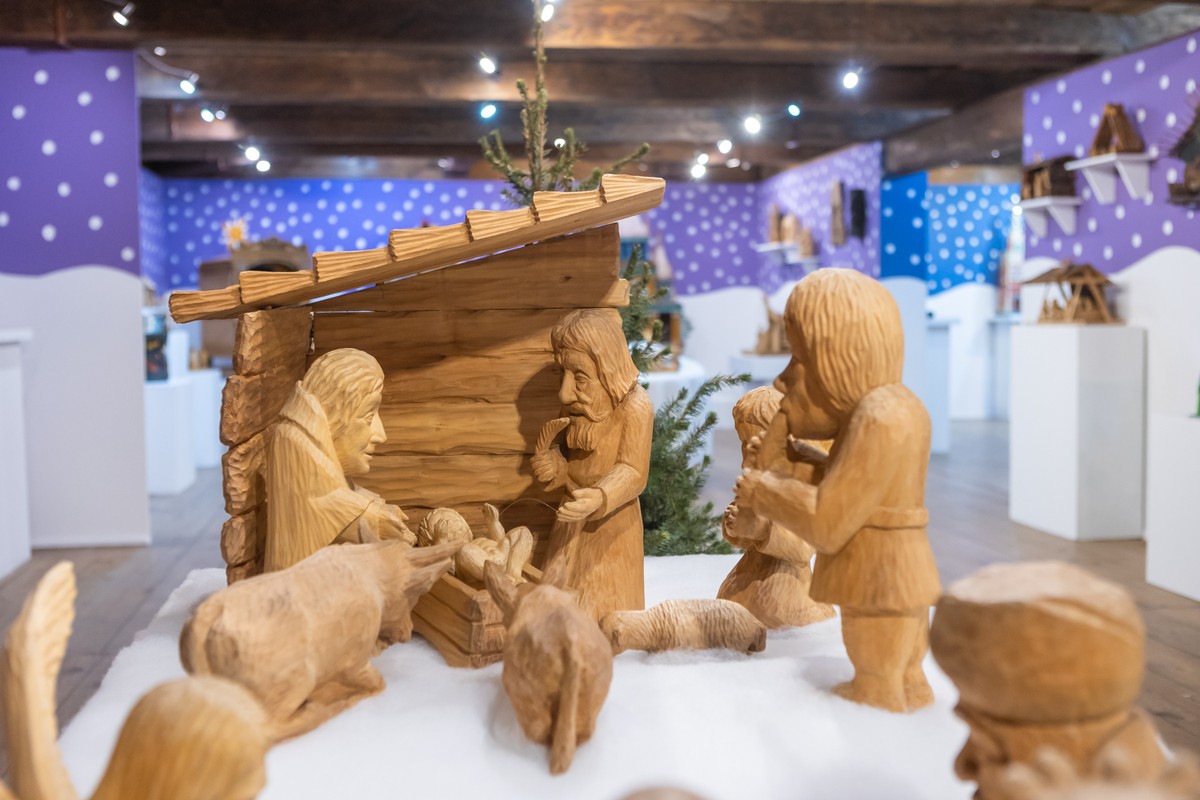
Nativity scenes exhibition in Etnographic Museum, photo by Mikołaj Kuras for UMWKP
Which contemporary artists are particularly inspired by Christmas themes?
The exhibition includes a large number of sculptural nativity scenes created in regions close to us. These are works by Wiktor Chrzanowski from Toruń, Józef Juraszek from Grudziądz, Jerzy Konera from Brodnica, Wiktor Węglerski from Handlowy Młyn, and Piotr Woliński from Kcynia. The oldest sculptural nativity scene presented in the exhibition was carved in 1953 by Jan Centkowski from Nieszawa.
These works are highly diverse, ranging from simple, unpainted small pieces to multi-element, colourful compositions. The theme of Christmas continues to inspire non-professional artists, including those from the Kujawsko-Pomorskie Region. This was evident at the most recent fair held at the Ethnographic Museum, where Józef Walczak from Więcbork, Zygmunt Kędzierski from Przymuszewo, and Jakub Kubiak from Jarantowice sold their works. Among them were traditional nativity scenes as well as sculptures and reliefs depicting the miracle of the Saviour’s birth. The works of these artists are also featured in the exhibition.
What did the tradition of carolling with a nativity scene involve?
Carolling took place from Advent (in Kociewie, the Tuchola Forest, and Chełmno Land) or from the second day of Christmas (in Kujawy and Pałuki) until 2 February, the Feast of Candlemas. Nativity scene carollers were usually boys, bachelors, and adult men—often representatives of professions that were inactive in winter, such as bricklayers or carpenters.
They went individually or in small groups, with the nativity scene sometimes serving as their only prop. At times, they were part of larger groups of carollers carrying a star or wearing animal masks. Some were accompanied by musicians playing the violin, accordion, or burczybas (a traditional friction drum).
Carollers with nativity scenes featuring static figures usually sang carols and offered good wishes. Those using puppet nativity scenes performed a spectacle depicting the Nativity and the Adoration of Jesus, the homage of the shepherds, and the visit of the Three Kings. The performances also featured characters representing different social classes, professions, ethnic and national groups, ethnographic types, and mythical figures such as the devil or a witch. Hidden behind the nativity scene, the caroller moved the puppets, sang, and recited rhymed texts, often humorous in nature.
Visits by nativity scene carollers were a major attraction for villagers and townspeople alike, especially in households with children. They could be encountered in all regions, and carolling with a nativity scene often became a family tradition.
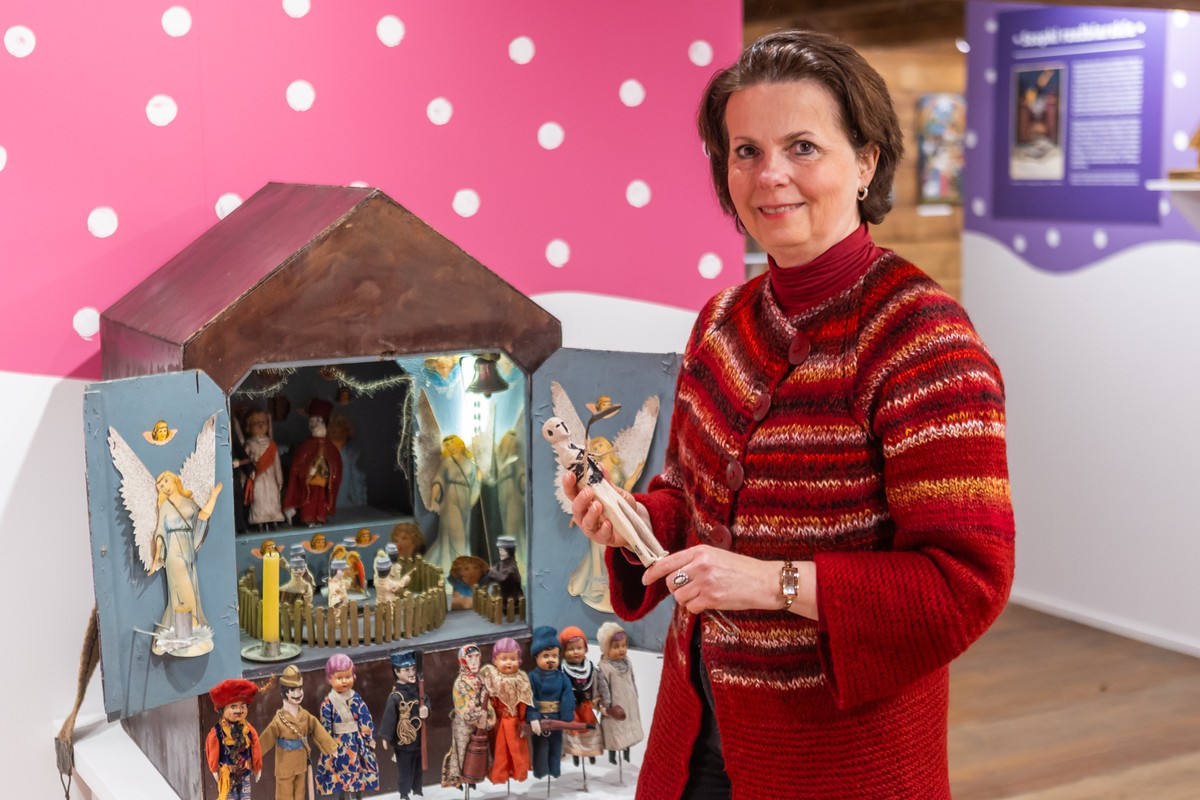
Hanna Łopatyńska, photo: Mikołaj Kuras for the Marshal’s Office of the Kujawsko-Pomorskie Region
What Christmas wishes did the former inhabitants of villages in Kujawy, Pałuki, and the Tuchola Forest express?
Nativity scene carollers, like those carrying other props (such as a star or animal masks), wished household members health, happiness, and prosperity. These wishes were delivered at the end of the visit, and in return the carollers received gifts—food or money. It was believed that only wishes for which payment was given would come true.
Sometimes the wishes took the form of an oration or a carol of blessing, for example:
May God grant you as many oxen
As there are fence posts,
As many sheep as ants in the forest,
And in the fields, sheaf upon sheaf,
Stack upon stack,
And the farmer among the stacks
Like the moon among the stars.
(Text of a blessing carol recorded in Chełmno County, 1930s; after: B. Stelmachowska, The Ritual Year in Pomerania, Toruń 1933, p. 76.)
We also spoke with Hanna Łopatyńska about Easter traditions.
19 December 2025